Flex strategy adoption just hit a record high. But does that mean flex space has actually become the default?
- A record share of occupiers, 84%, now say they have a flex strategy in place, up from 76% in 2025, according to CBRE's newest Americas Office Occupier Sentiment survey.
- Having a strategy and treating flex as the default are not the same claim, and the actual share of office space consumed flexibly tells a more cautious story.
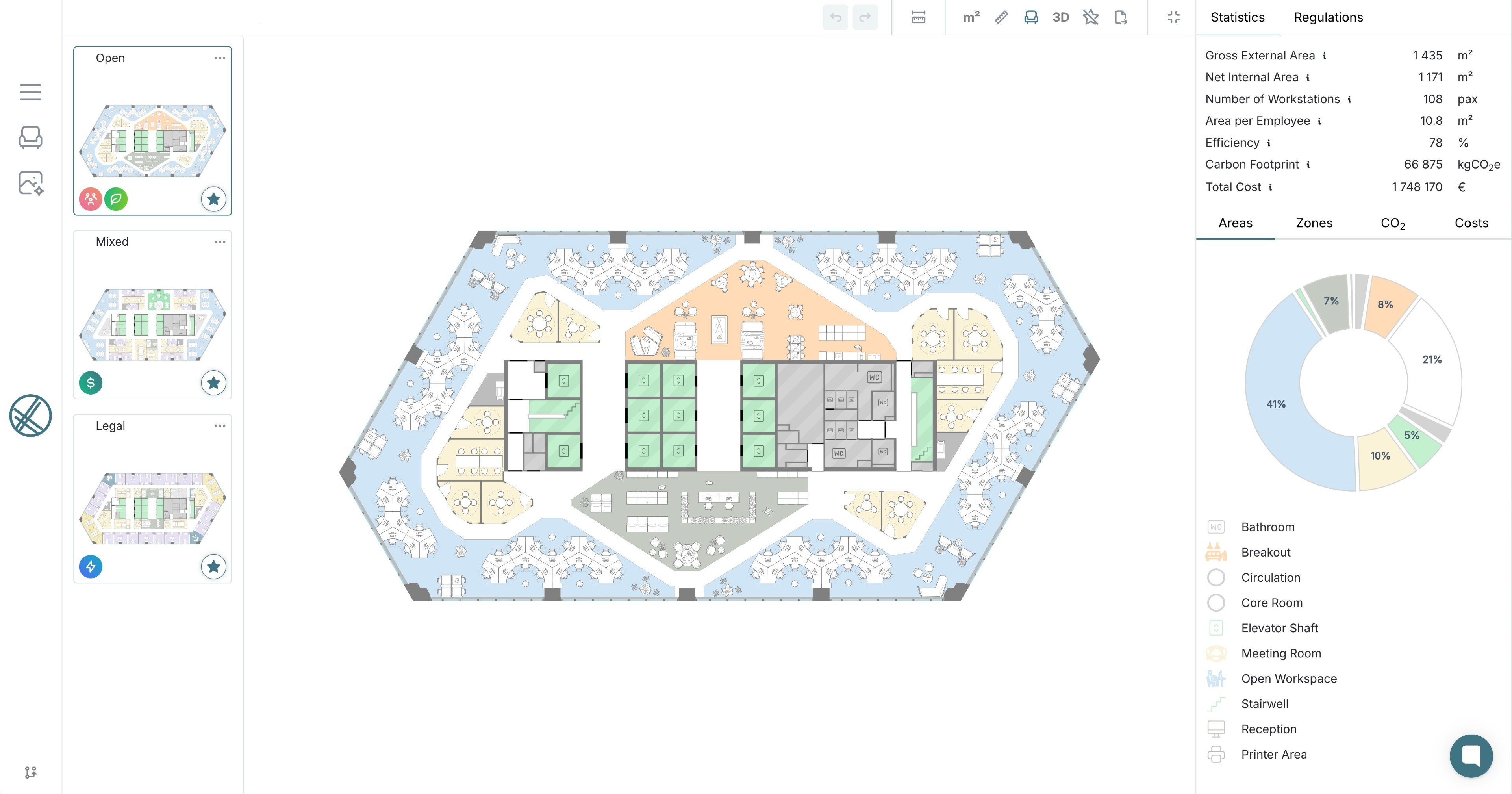
- laiout lets operators close that gap, turning stated intent into an occupied floor before a prospect's plan cools.
The short answer to the question in the headline: not yet, not in actual square footage, even as intent has never been higher. CBRE's newest Americas Office Occupier Sentiment survey, released late July 2026, found 84% of occupiers now have some flex strategy in place, a record high, with capex avoidance cited as the top reason they choose flex over a direct lease. But a flex strategy is a document, not a floor plate, and the evidence for flex as the actual default is thinner than that headline number suggests.
- Flex strategy adoption is at a record high: 84% of occupiers now report having a flex strategy, up from 76% a year earlier, per CBRE's survey.
- Actual space consumed flexibly is still small: Coworking and flex space represent roughly 2.3% of the national commercial real estate market today, according to Coworking Cafe's Q2 2026 report, even as JLL projects that up to 30% of office space could be "consumed flexibly" by 2030. The gap between those two numbers is where most of the real opportunity still sits.
- Flex space is maturing into a searchable category: Hubble, a flex marketplace backed by Yardi, just launched in the US, aggregating major operators and hundreds of independent providers into a single comparable listing, a sign flex is becoming a category tenants shop rather than stumble into, the same shift behind why operators are already winning enterprise contracts on speed alone.
That maturity extends beyond the big gateway cities: US coworking locations grew 2.7% in Q2 2026 to roughly 9,400 total, per Coworking Cafe, with more of that growth landing in secondary and tertiary markets, the same shift already reshaping where flex growth is really happening beyond the central business district. None of this argues for slowing down on flex, only for making sure the space matches the strategy the moment an enquiry lands, not weeks later after a design brief is briefed and re-briefed, the same discipline behind why demand is real and speed is what actually delivers it.
An operator's relationship with a prospect doesn't end at the first configured layout, it starts there. The space still has to be marketed while the prospect is deciding, and it still has to be findable and reconfigurable long after they sign.
- Convert the first enquiry into a configured, branded space on the spot: Generate a compliant layout against a prospect's actual headcount in minutes, compliance checked automatically for the market the building sits in, the same test fit modelling that replaces days of architect time with minutes. Multi-tenancy configuration handles a 20-person and a 50-person client on the same floor without starting over.
- Put the live layout on your own marketing site, not a static brochure: Embed any plan into a location page as an interactive Live Listing that updates automatically whenever the underlying plan changes, so prospects always see the current configuration, not a PDF from three reconfigurations ago, the same transparency already winning enterprise contracts on speed alone.
- Keep every plan across the portfolio in one searchable library: Every layout lands automatically in laiout Hub, included in the standard subscription and open to the whole team, ready the moment a member asks to grow or a new site needs scoping, the same centralisation landlords use to replace CAD-locked floor plans with a spatial hub.
Q: What percentage of US office space is flexible today?
Coworking and flex space represent roughly 2.3% of total US office inventory today. JLL projects that share could reach 30% by 2030, which shows how much of the shift is still ahead rather than already complete.
Q: How fast can an operator actually configure a space for a new enquiry?
A first layout generates in minutes from an uploaded floor plate, whether the enquiry comes through a marketplace listing, a direct call, or an existing member asking to grow. Comparing two or three configuration options for the same floor typically takes under an hour.
Q: Does laiout replace an operator's own sales and design process?
No. laiout accelerates the step between a stated interest and a space an occupier can actually picture and commit to. Your team still owns the relationship, the pricing and the final configuration decision.
Flex has clearly won the argument at the strategy level. But the operators who benefit from that shift won't be the ones with the most polished flex policy on file, they'll be the ones who can turn a stated intent into an occupied floor before a prospect's plan cools.
Book a demo with laiout today and find out how quickly your next flex enquiry could go from stated strategy to signed space.
- 84% of occupiers now report having a flex strategy in place, up from 76% in 2025, according to CBRE's latest Americas Office Occupier Sentiment survey.
- Coworking and flex space still represent only around 2.3% of total US office inventory today, despite the record in strategy adoption.
- Capex avoidance is the top reason occupiers choose flex over a direct lease.
- JLL projects that up to 30% of office space could be consumed flexibly by 2030, a scale far beyond current usage.
- US coworking locations grew 2.7% in Q2 2026 to roughly 9,400, with growth increasingly concentrated in secondary and tertiary markets.
- A new US flex marketplace from Hubble, backed by Yardi, is aggregating major and independent operators into a single comparable listing.
- laiout closes the gap between a stated flex strategy and an occupied floor, from the first configured layout through to Live Listings and portfolio-wide storage in laiout Hub.
- Hubble's US expansion signals maturation of flex office market, Facilities Dive, 13 August 2026.
- U.S. Coworking Industry Report Q2 '26, Coworking Cafe, 23 July 2026.
- The Flexible Office Space Imperative, JLL, 14 April 2026.
Author: Theodore Harding, laiout
Get laiout News and Updates right in your inbox.

We're always open to hearing from talented people. If you don't see an open role that fits, send a speculative application to careers@laiout.co.Tell us what you'd bring and why laiout resonates with you.

Sign up to our newsletter


.svg)
.svg)


.svg)

