Generative design for architects or instant test fits for deal teams? A fair comparison of laiout and Finch.
Updated October 2026. This comparison reflects publicly available information as of 1 October 2026.
laiout is self-service AI test fit software that generates commercial office layouts in seconds, exports them straight to Revit, CAD and PDF, and turns any design into AI static and video renders in seconds to minutes. Finch is, per its own materials, a generative design platform for architecture and AEC teams. In our view, laiout is the stronger choice for office leasing decisions, and Finch for architectural design exploration across building types.
- Finch and laiout both use AI to generate floor plans, but they are built for different people. laiout is built for the deal team making a leasing decision on an office, while Finch describes itself as built for architecture and AEC professionals designing buildings.
- In our view, laiout is the stronger choice when the job is an office test fit for a landlord, tenant or broker, since it is instant, self-service and usable without design software. Finch is the better fit when an architecture firm wants to encode its own design standards and explore options across building types.
- The platforms overlap on office test fits, which is why they are often compared, but they are not direct substitutes, and some teams will use both.
Traditionally, a simple office test fit takes days to weeks from brief to finished plan, even though the drafting itself is only a few hours of architect time for a single floor plate. Fees run from a few hundred to several thousand dollars, and test fit agreements commonly range from $0.12 to $0.15 per square foot. Finch and laiout both automate part of that work, but for different users.
- Different primary users: laiout serves landlords, tenants, brokers, designers and flex operators from a browser, while Finch was, according to AEC Magazine, originally developed by architects as an in-house Rhino plug-in, and is built around the architect's workflow.
- Different scope: Finch covers several building types, with its own materials listing master planning, residential, high-rise and office, whereas laiout focuses on one: commercial office space planning.
- The overlap is real but partial: Both generate office layouts, so they are often compared, and the practical difference is whether the person who needs the layout is making a deal or designing a building.
- Built for: laiout serves landlords, tenants, brokers, designers and flex operators. Finch serves architecture and AEC professionals, per its own materials.
- Working style: laiout generates layouts in seconds, adjusts them live and shares them by link. Finch lets teams encode their firm's design standards and test many design options with real-time data, per its own materials.
- Building types: laiout focuses on commercial offices. Finch lists master planning, residential, high-rise and office, per its own materials.
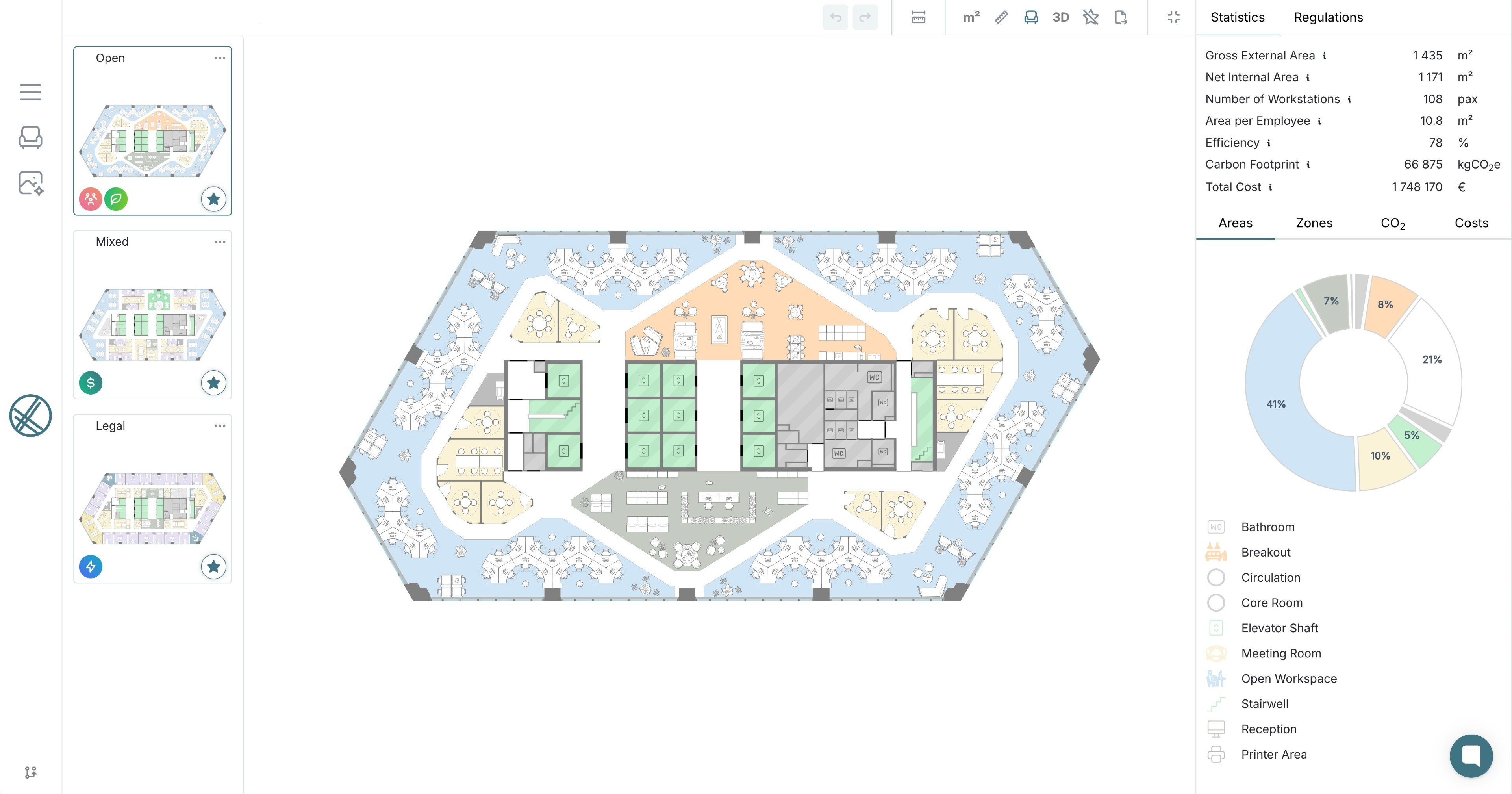
- Output: laiout provides optimised test fits, AI static and video renders in seconds to minutes (a premium add-on), 3D walkthroughs and live capacity, cost and carbon metrics, with exports to DWG, DXF, RVT, IFC, OBJ, PDF and CSV. Finch provides floor plans, area calculations and BIM geometry with real-time performance data, per its own materials.
- Integration: laiout works in the browser, with a Revit plugin that brings the chosen layout back as native, editable Revit elements. Finch integrates natively with Rhino, Grasshopper and Revit, according to independent reviews.
- The user is a deal-maker, not a designer: Landlords, tenants and brokers can generate and adjust a test fit themselves, with no design software and with onboarding typically completed in a single session.
- A leasing conversation is live: Generate a layout in seconds and adjust it with the client in the room, the same logic behind why speed wins in competitive leasing markets.
- The output must reach people outside the design team: AI static and video renders, 3D walkthroughs and shareable links work for stakeholders who never open CAD, while exports to DWG, DXF, RVT, IFC and OBJ serve those who do.
- You want one focused workflow: With a single building type, the platform is built around commercial office planning from the first click.
- You are an architecture firm with your own standards: Finch lets teams encode their firm's design systems and apply them to every new design, per its own materials.
- You work across building types: Finch covers several building types, with office alongside other uses, per its own materials.
- Your workflow lives in Rhino, Grasshopper or Revit: Native integration keeps generated plans inside the design environment your team already uses.
- You want to explore many options with performance data: Per its own materials, Finch lets teams test thousands of design options with real-time data.
- Who needs the layout? A landlord, tenant or broker points to laiout. An architect or design team points to Finch.
- What stage is the work? A leasing decision on an office points to laiout. Early-stage building design across building types points to Finch.
- Where does the work live? In a browser, shared with the deal team, points to laiout. Inside Rhino, Grasshopper or Revit points to Finch.
Q: Is Finch or laiout better for office space planning?
In our view, laiout is the stronger choice for office leasing decisions, because it is instant, self-service and usable by landlords, tenants and brokers without design software. Finch suits architecture firms that want to encode their own design standards and explore options across building types. Our guide to choosing AI test fit software sets out five criteria for weighing platforms.
Q: Does Finch generate office test fits like laiout?
Finch's own materials list office test fits among its use cases, so the platforms overlap. The difference is the user and the workflow: Finch is built for architecture and AEC professionals and, per independent reviews, integrates natively with design software, while laiout is built for the deal team making a leasing decision, working in the browser.
Q: What are alternatives to Finch for AI floor planning?
The right alternative depends on the job. laiout is built for instant, self-service office test fits that landlords, tenants, brokers, designers and flex operators generate, adjust and export themselves. Other platforms focus on different jobs, such as site feasibility, enterprise workplace programmes or structuring existing floor plans into data, so it helps to start with the stage of the project you need to support.
Q: Is Finch or laiout better for architects?
Architects who want to encode their firm's standards and work inside Rhino, Grasshopper or Revit may prefer Finch. Architects who need a fast office test fit for a client or a leasing pitch, and want to bring the chosen layout back into Revit, can use laiout, whose Revit plugin returns it as native, editable elements.
Q: Does laiout work with Revit and Rhino like Finch?
Finch integrates natively with Rhino, Grasshopper and Revit, per independent reviews. laiout connects through its Revit plugin and file exports to DWG, DXF, RVT, IFC, OBJ, PDF and CSV. Teams that work mainly in Rhino or Grasshopper should check which workflow suits them.
Q: Can a team use both laiout and Finch?
Yes. An architecture firm can use Finch to explore designs across building types, and use laiout for the instant office test fit that a landlord, tenant or broker needs during a leasing conversation.
In our view, laiout is the stronger choice for office leasing decisions. It is instant, self-service, usable by the whole deal team, and puts live capacity, cost and carbon data and Revit-ready exports in your hands straight away, with AI static and video renders following in seconds to minutes. Finch earns its place where architecture firms want to encode their own standards and explore designs across building types, and some teams will sensibly use both.
If the next step is a leasing conversation, book a demo with laiout today and see an office test fit generated, adjusted and exported in front of you.
- laiout is built for the deal team making an office leasing decision, while Finch describes itself as built for architecture and AEC professionals.
- A traditional architect-led test fit can take days to weeks to turn around and can cost from a few hundred to several thousand dollars.
- Finch lets firms encode their own design standards, per its own materials, and integrates natively with Rhino, Grasshopper and Revit, per independent reviews.
- laiout adds live capacity, cost and carbon data, AI static and video renders, 3D walkthroughs and exports to DWG, DXF, RVT, IFC, OBJ, PDF and CSV.
- The two overlap on office test fits but are not direct substitutes, and a team can use both.
- In our view, laiout is the stronger choice for office leasing decisions, and Finch for architectural design exploration across building types.
- What Is a Test Fit in Commercial Real Estate? How Developers Use Them, Build, March 2026.
- Why Tenants Should Use A Test Fit, Park Real Estate Advisors.
- Finch3D Review 2026: How Generative AI Is Changing Early-Stage Architectural Design, Illustrarch, 2026.
- Finch untethered, AEC Magazine.
Author: Theodore Harding, laiout
Get laiout News and Updates right in your inbox.

We're always open to hearing from talented people. If you don't see an open role that fits, send a speculative application to careers@laiout.co.Tell us what you'd bring and why laiout resonates with you.

Sign up to our newsletter


.svg)
.svg)


.svg)

