AI is saving designers time, but few practices have turned it into higher fees. Here is where early-stage speed pays.
- Adoption: 74% of surveyed practices use AI on at least some projects, up from 59% in 2025 and 41% in 2024, though most remain at an early stage.
- The gap: 73% of AI users report better productivity, yet only 7% say AI has allowed their practice to increase fees.
- laiout: Early-stage layouts are where the time comes back, and where designers can show clients more options while keeping the design judgement with people.
RIBA's AI Report 2026, based on more than 1,100 responses collected in March and April, shows a profession that has adopted AI quickly and is still working out what to do with the time it saves.
- Adoption is broad but still early: 74% of surveyed practices use AI on at least some projects, and 31% on every or most projects, up from 6% in 2024. In the report's maturity breakdown, 62% remain at an early stage of deployment and only 15% say AI is embedded in day-to-day work. Over 90% of large practices use it, against 63% of small ones.
- The time is saved, the fee is not: 73% of AI users say it improved productivity, 57% of those assessing ROI report a positive return, and 44% of AI users say it has let them devote more time to creative, high-value work. Only 7% of AI users say it has allowed their practice to increase project fees.
- Human judgement is the product: 77% agree AI can never replace human creativity and 61% agree it will make it harder for early-career professionals to gain skills, as the CIC's summary of the findings also highlights. Just 19% of practices have a documented AI policy, rising to 56% of large practices.
The first stage of a project is where AI time savings are easiest to bank and easiest to show a client. laiout lets you:
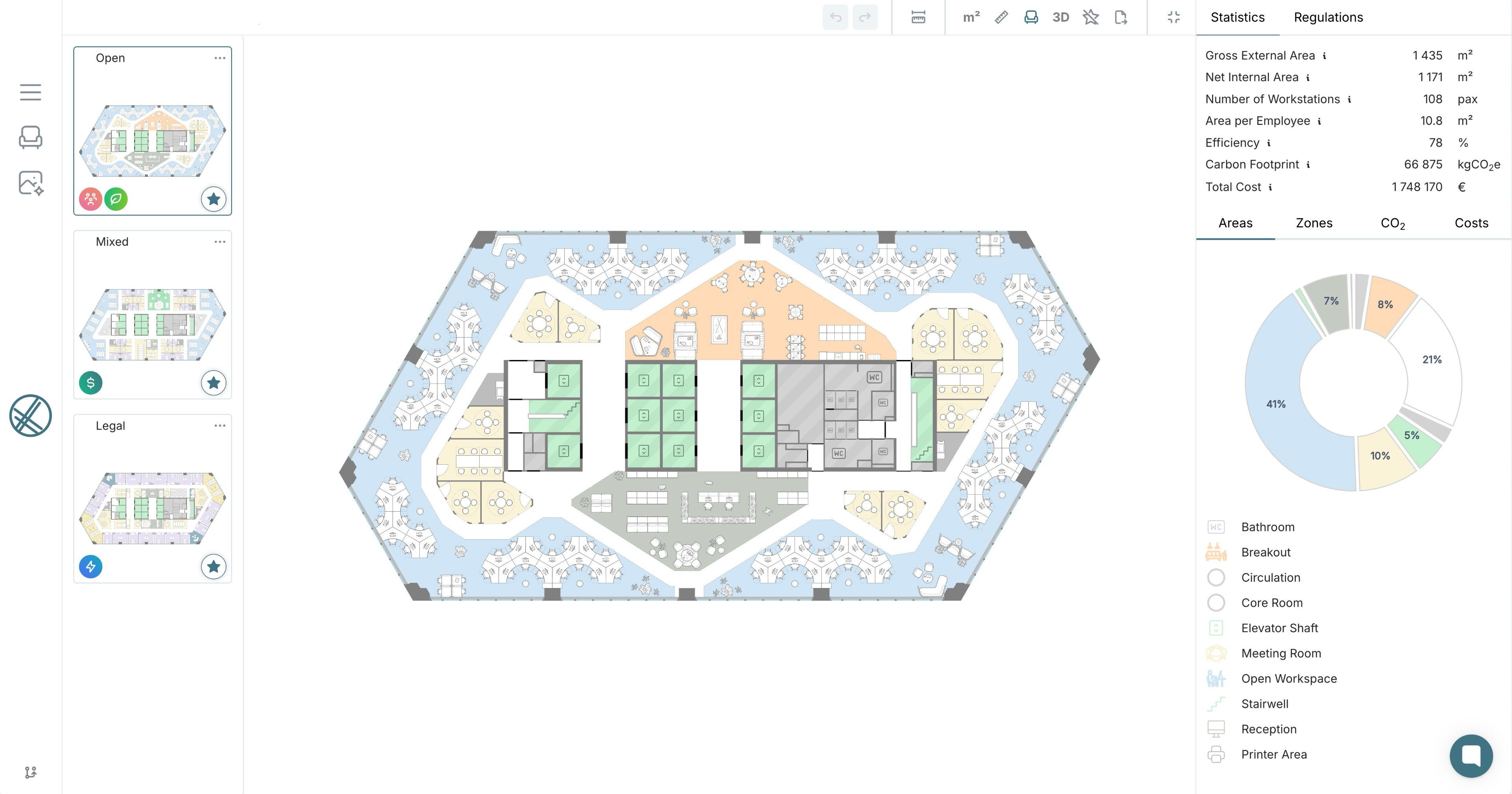
- Replace one option with a spread: Set the brief (room types, quantities, density), generate multiple layouts in seconds and compare them on live capacity, efficiency, cost and carbon. The first client meeting shows range and trade-offs, not a single drawing. Fire exit distances can be checked against the rules for the UK, UAE, China, Germany, USA and Singapore.
- Keep the pen with the designer: Refine layouts with zone editing, upload your own furniture and export to Revit, IFC or DXF, with furniture optionally grouped into blocks, so detailed design continues in your tools. The generated layout is a first draft and your judgement shapes the rest.
- Make the value visible to the client: Turn options into AI stills and short video renders with Lock Style for a consistent look, and share them with stats in a link or branded PDF. A concept-stage cost and carbon estimate gives clients something to value beyond a layout.
Q: How should design practices price early-stage work when AI reduces the hours?
Most practices are still working this out, with only 7% of AI users saying it has allowed them to increase fees. One approach is to price on what the client receives, such as a set number of tested options with metrics, rather than the hours spent drawing them. Our piece on how architecture firms are defending their fees covers the commercial side.
Q: Can clients rely on AI-generated office layouts?
RIBA's report shows 55% of respondents agree AI will let people without professional qualifications design buildings, so oversight matters. Present laiout output as a first draft that you review, with fire exit distance checks supported and detailed design developed in Revit or CAD under your professional judgement.
Q: Does laiout work with Revit and CAD?
Yes. Outputs export to Revit, IFC and DXF, and the Revit plugin brings layouts into your existing workflow. See also how commercial design studios are absorbing the cost of early-stage test fits.
AI will keep saving time at the start of projects. The practices that benefit commercially will be those that turn that time into something clients can see: more options, clearer trade-offs and better conversations. Our earlier piece on how AI space planning shifts designers from iteration to curation explains why curation is where design taste shows, and you can book a demo with laiout to see how much further the first week of a project can go.
- 74% of surveyed practices use AI on some projects, up from 41% in 2024.
- 62% remain at an early stage of deployment and only 15% say AI is embedded in daily work.
- 73% of AI users report better productivity, but only 7% say it has allowed their practice to increase fees.
- 44% of AI users say it has given them more time for creative, high-value work.
- 61% worry about early-career skills, and only 19% of practices have a documented AI policy.
- laiout turns the early stage into a spread of tested options, with the design judgement staying with people.
- RIBA AI Report 2026, RIBA, fieldwork March to April 2026.
- AI adoption reaches tipping point across UK architecture, Construction Industry Council, 23 July 2026.
Author: Theodore Harding, laiout
Get laiout News and Updates right in your inbox.

November 18, 2026
How Many Meeting Rooms Does an Office Need? Ratios and Room Mix
November 13, 2026
Landlords Are Finding Refurbished Office Space Harder to Let Despite Falling Vacancy
November 11, 2026
NIA vs GIA: How Office Floor Area Is Measured and What It Means for Your Rent
We're always open to hearing from talented people. If you don't see an open role that fits, send a speculative application to careers@laiout.co.Tell us what you'd bring and why laiout resonates with you.

Sign up to our newsletter


