How office floor area is measured, why NIA and GIA differ across standards, and what it does to your rent.
- Gross vs net: Gross area counts the whole building footprint. Net internal area (NIA) counts the space people can actually use.
- No single rule: RICS, IPMS, BOMA and Germany's GIF guideline each draw the line in different places, so the same floor can carry different numbers.
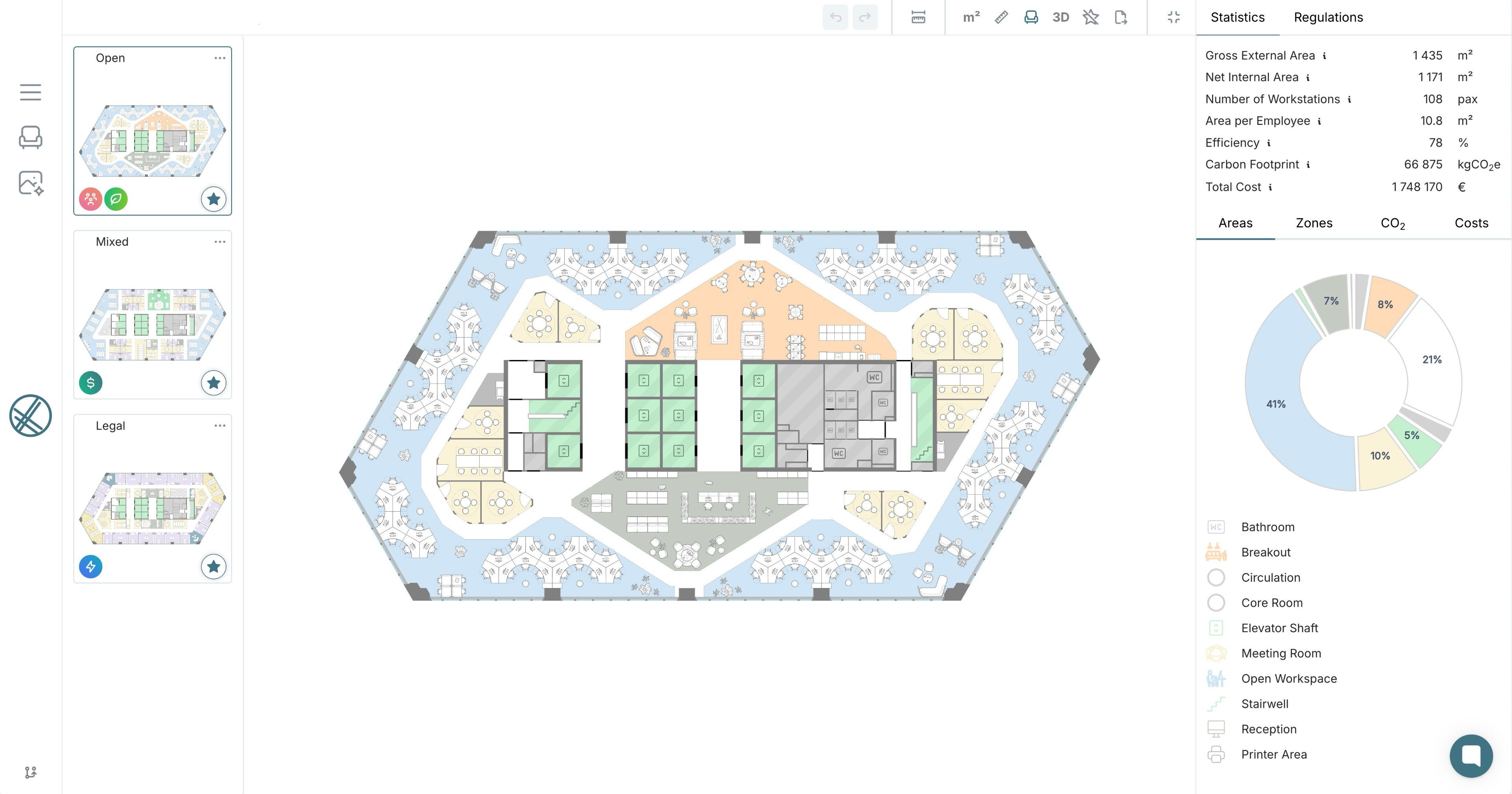
- laiout: It calculates NIA, GEA and efficiency live from the layout, on RICS or GIF standards.
Two buildings with the same headline size can offer very different usable space. A widely cited valuation office definition describes gross internal area (GIA) as the whole enclosed area within the external walls, including internal walls, columns, stairwells and plant rooms. NIA is the usable area measured to the face of the internal finish, excluding toilets, lobbies, lift and stair wells, plant rooms and structural walls and columns.
- Each standard draws the line differently: The IPMS Coalition, made up of more than 80 property organisations, published IPMS: All Buildings in January 2023 as a global open-source standard for a uniform approach to measuring buildings. The BOMA 2017 office standard covers gross, useable and rentable area and was aligned with IPMS. Germany's gif guideline, as explained by Görg, starts from gross floor area under DIN 277 and divides it into lettable and non-lettable space.
- The basis moves the rent: Cushman and Wakefield's worked example takes a floor of 10,000 sq ft NIA that measures 10,500 sq ft on IPMS. A £300,000 rent is £30.00 per sq ft on NIA but £28.57 on IPMS. Landlords most often keep the higher annual rent, so the quoted rate looks lower while the bill does not change.
- A standard only counts if the lease names it: The Görg article notes that gif guidelines are not legal regulations, but the work of a private expert association, and recommends attaching the relevant guideline to standard-form contracts. The RICS says that until its 7th edition is published (consultation closed 13 October 2026), practitioners should use the 6th edition and/or IPMS: All Buildings and document the basis.
Area figures only compare when they share a basis. laiout puts every option on one:
- Set the basis once and compare like with like: Choose RICS or GIF in Advanced Preferences, and NIA and GEA are calculated to that standard. Apply the same space programme and preferences to every building on a shortlist, and the statistics panel compares them on a like-for-like basis.
- Judge a floor by what it delivers: Efficiency shows NIA as a proportion of GEA, next to desk count, capacity, density and estimated fit-out cost. That lets you compare cost per workstation across buildings and not just rate per sq ft.
- Bring the evidence to the negotiation: Choose whether a shared link shows GEA and NIA, export statistics to CSV, and include the stats in a branded PDF. Add renders to the link or PDF so the numbers sit next to the space they describe. Your agent, finance team and surveyor can then check the plan against the lease.
Q: What is the difference between NIA and GIA?
GIA is the whole enclosed area within the external walls, including internal walls, columns, stairwells and plant rooms. NIA is the usable area measured to the face of the internal finish, excluding toilets, lobbies, lift and stair wells and structural walls. Rent is usually quoted on a net or rentable figure, so the gap between the two matters.
Q: My agent quoted 12,000 sq ft, but my test fit shows 11,400. Which is right?
Possibly both. Ask which standard the quote follows and what it includes. Rentable and IPMS-style figures can include items such as columns or a share of common areas that a net usable figure leaves out, so the same floor reads higher. Ask for the basis in writing.
Q: How do I convert gross area to NIA for an office?
As a rough guide, the BCO 2019 Guide to Specification puts NIA:GIA efficiency for UK low-rise offices (up to nine storeys) at 80 to 85%. Other markets and building types differ, so confirm it with a test fit. Our guide to how much office space you need shows the maths, and rentable vs usable square feet covers the BOMA approach used in the US.
A rate per square foot or square metre is only comparable when the area underneath it is. Ask which standard applies, get it written into the lease, and test the floor against the layout you actually plan to build. Our piece on using fit-out cost data to negotiate better leases covers the next step. Book a demo with laiout and see NIA, efficiency and capacity on your own floor plan.
- Gross area counts the whole building. NIA counts usable space only.
- RICS, IPMS, BOMA and the German GIF guideline each define area differently.
- On one worked example, IPMS added about 5% to the same floor.
- Landlords usually hold the annual rent, so the quoted rate falls while the cost stays put.
- laiout calculates NIA and GEA on RICS or GIF standards and compares buildings on one basis.
- Ask for the standard in writing before comparing any two rates.
- Code of measuring practice: definitions for rating purposes, HMRC (VOA).
- International Property Measurement Standards, IPMS Coalition, published 16 January 2023.
- BOMA International 2017 Office Standards, Cresa.
- Flächenberechnung bei Mietobjekten: Die neuen gif-Richtlinien, Görg, 1 May 2013.
- The difference between IPMS and NIA rental values, Cushman and Wakefield, 15 November 2023.
- Code of Measuring Practice, RICS.
- 2019 Guide to Specification summary, BCO.
Author: Theodore Harding, laiout
Get laiout News and Updates right in your inbox.

We're always open to hearing from talented people. If you don't see an open role that fits, send a speculative application to careers@laiout.co.Tell us what you'd bring and why laiout resonates with you.

Sign up to our newsletter


