Half of operators now prefer management agreements. See what to test on a floor before you commit.
- The shift: 50% of operators prefer management agreements, up from 44% in 2023, and 95 percent of IWG's H1 2026 signings were delivered through managed partnership agreements.
- The risk: A management agreement carries less lease risk, but the plan still has to prove desk count and fit-out cost before terms are agreed.
- laiout: Test any floor plate in minutes, compare capacity, cost and carbon, and share the result with the landlord.
Coworking Europe's 2026 survey of 199 operators across 39 countries found global flex occupancy at a record 85%, up from 81%, with 76% of operators planning to expand over the next year. The question is how to grow into that demand without taking on fixed rent.
- Management agreements are now mainstream: IWG signed 728 new locations in H1 2026, up 47%, with about 95% through its capital-light model. Recurring management fees rose 84% to $35 million, according to Allwork.Space's report on IWG's interim results.
- Demand favours fitted space: CBRE's European Flex Market report shows average deal size dropped from 34 desks to 26 even as deal volume rose. Managed offices, which are fully fitted, are the fastest-growing segment.
- The plan has to be right before the deal is: Smaller, fitted deals mean more floors to assess, so each one needs a desk count, a room mix and a fit-out cost before terms are agreed. Meeting rooms are the most sought-after amenity, followed by phone booths and collaboration spaces, so test the room mix too.
A ratio or a landlord's brochure is a starting point. The value is in testing the actual floor:
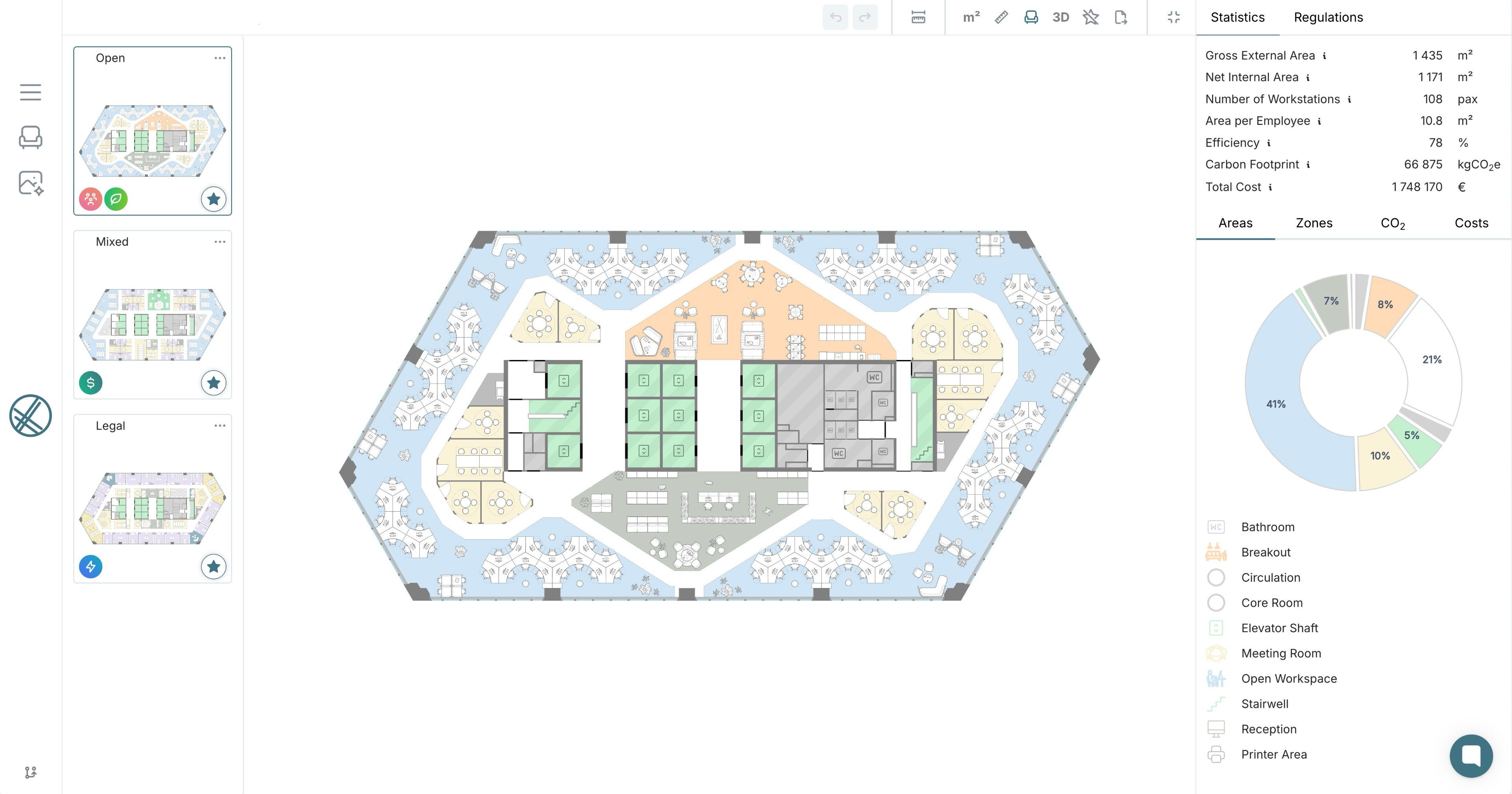
- Scout a floor in minutes: Upload the prospective building's floor plan, set the desks, meeting rooms and phone booths you want, and generate layouts in seconds. Desk count, capacity and compliance checks show before you commit. Add Pod Areas, a zone type separate from meeting rooms, for phone booths.
- Compare floors like for like: Copy the same preferences across floors and projects so every option starts from one brief, and save each layout as a favourite. Each one stores its desk count, NIA, GEA and zone breakdown, with NIA and GEA calculated to RICS or GIF standards. The Statistics panel adds capacity, density, estimated fit-out cost and carbon.
- Share the evidence with the landlord: Send a shared link with the stats you choose, plus 3D, AI renders and videos, and require an email to see who has opened it. Export statistics to CSV, or build a branded PDF with your logo. Both sides then negotiate from the same plan.
Q: What is a management agreement in flex space, and how is it different from a lease?
Under a lease, the operator pays a fixed rent whatever the occupancy. Under a management agreement, the operator runs the space in the landlord's building for a fee or a share of revenue. Coworking Europe's 2026 survey found half of operators prefer management agreements.
Q: How can we estimate desk capacity quickly? A landlord has offered us three floors across two buildings and wants an answer this week.
Run the same brief on each floor: target desks, meeting rooms and phone booths. Compare capacity and estimated fit-out cost, then send the landlord a shared link with your preferred option. Our piece on why speed wins in competitive leasing markets covers why a quick, evidenced answer matters.
Q: Does laiout replace our architect or fit-out team?
It sits alongside them. laiout gives you fast, comparable options, and the design judgement stays with people. Layouts export to Revit, IFC and DXF for detailed design. See also how flex operators are standardising space planning across networks.
With occupancy at record levels and more operators choosing capital-light deals, the winners will be those who judge each building quickly and back the judgement with a plan the landlord can see. Our guide to how much office space you need shows the maths behind desk counts, and you can book a demo with laiout to test your next building before you sign.
- Global flex occupancy reached a record 85% in 2026, up from 81%.
- 76% of operators plan to expand, and 50% prefer management agreements, up from 44% in 2023.
- About 95% of IWG's H1 2026 signings came through managed partnership agreements.
- Average flex deal size fell from 34 desks to 26 as deal volume rose.
- Meeting rooms are the most sought-after flex amenity.
- laiout lets operators test, compare and share floor options before agreeing terms.
- Global flex occupancy hits record 85%, Coworking Europe via Allwork.Space, 21 October 2026.
- European Flex Office Space Grows 3.4% As Demand Outpaces Supply, Allwork.Space, 12 November 2026.
- IWG Signs 728 New Flex Locations, Up 47% In 2026, Allwork.Space, 28 August 2026.
- IWG H1 2026 results coverage, Technode, 28 August 2026.
Author: Theodore Harding, laiout
Get laiout News and Updates right in your inbox.

We're always open to hearing from talented people. If you don't see an open role that fits, send a speculative application to careers@laiout.co.Tell us what you'd bring and why laiout resonates with you.

Sign up to our newsletter


