Demand for grade A space is growing, with a limited supply in the market. Landlords are moving quickly to take advantage of this opportunity.
UK office demand has tilted strongly to Grade A, while secondary space drags. Turning stranded space into lettable product lets landlords move from stranded to desirable by using rapid, measurable test‑fits to prove viability, then sequencing a light‑touch retrofit to hit demand.
Leasing is improving, but most activity is Grade A. Recent data shows Central London’s largest‑deal volume is at multi‑year highs and Grade A’s share of leasing is at record levels. Prime owners are seeing early signs of stabilisation and firmer demand. Secondary floors without a retrofit plan are being left behind.
Demand bifurcation. National take‑up has reached multi‑year highs on a rolling basis, with Central London showing the strongest mix of large deals since the late 2010s. Grade A’s share has approached four‑in‑five of lettings.
Prime stabilisation. Leading London estates report rising enquiry levels, early valuation stabilisation and office occupancy close to nine‑in‑ten.
Policy drivers. MEES obligations use a seven‑year payback test to evidence whether measures are cost‑effective.
Europe backdrop. Q2 data shows year‑on‑year growth in European office leasing, led by a flight‑to‑quality dynamic that favours space that offers more than the traditional proposition.
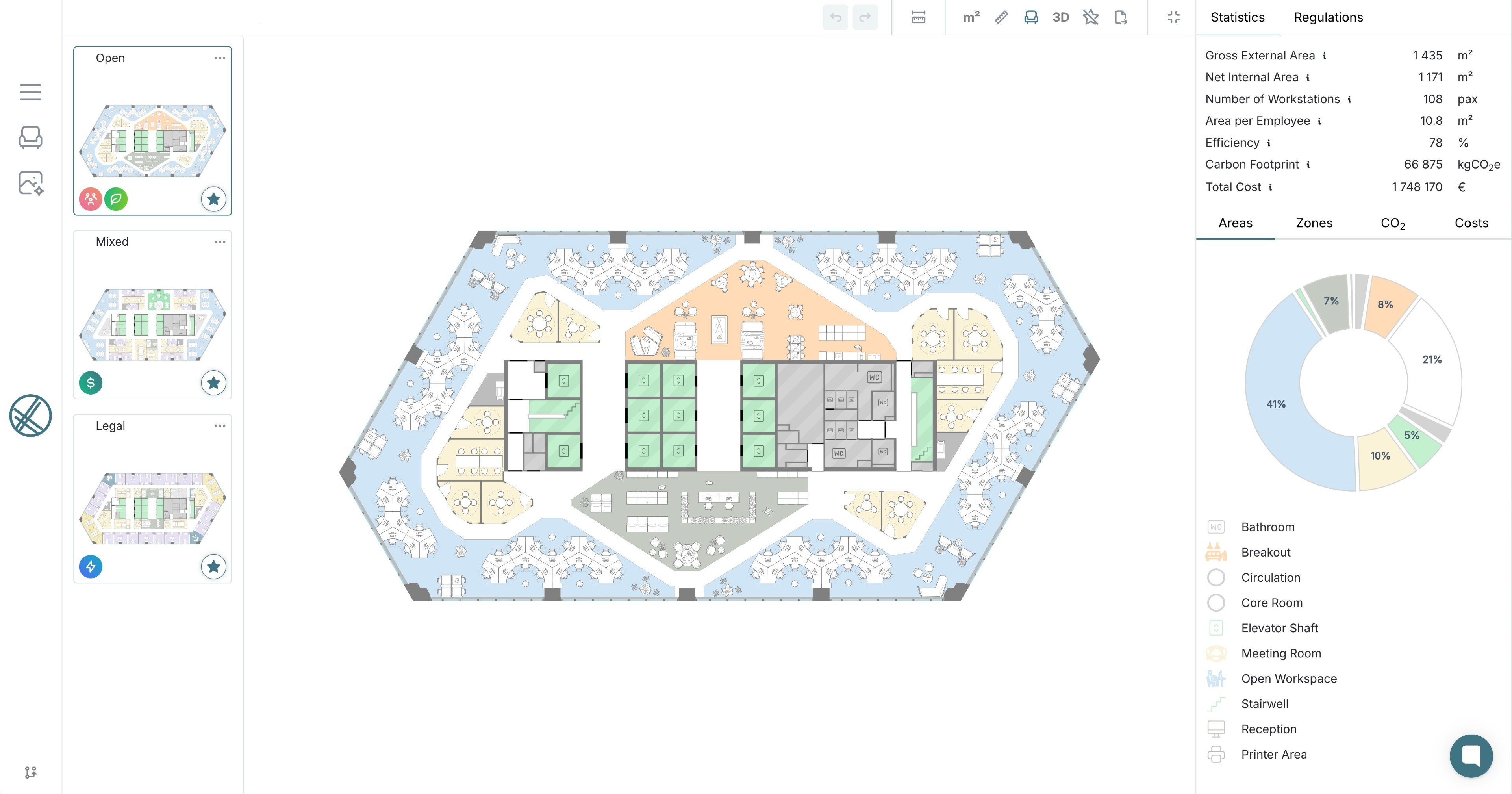
Speed to decision - laiout generates test‑fits in seconds, so a first tour can cover two or three viable layouts, and end with a decision pack that summarises capacity, programme, order‑of‑magnitude capex and indicative operating costs.
Measurable outcomes - Each option displays capacity, desk‑to‑meeting mix, circulation and compliance flags. As you adjust rooms or corridors, the metrics update instantly, making trade‑offs explicit and creating an auditable trail you can export for leasing and FM stakeholders.
Simple collaboration - Once the requirements have been workshopped live, then share a link for stakeholders to review options. Saved presets to compare choices, like “open‑plan heavy” or “client‑facing”, help to clearly indicate each test fits options focus and deliverability.
Code‑compliant planning - Location‑specific checks test travel distances, evacuation and accessibility routes against prevailing rules. This reduces redesign loops, clarifies what is feasible in the envelope, and speeds coordination with consultants.
Capacity, cost and carbon surfaced - Each scheme pairs capacity and density data with capex bands and operational carbon estimates, so landlords can evidence an EPC improvement. The pack equips CFOs with the numbers they need.
Q1: Is CAT A+ always required to compete with new build?
No. A light kit focused on improved acoustics, lighting and collaboration areas can close most of the gap when capacity, compliance and comfort are proven in the plan.
Q2: What if the building cannot reach EPC B cost‑effectively?
Use the seven‑year payback principle to evidence exemptions and sequence additional improvements as leases roll.
Q3: How do we shorten the term‑sheet cycle?
Bring the decision‑ready pack to the tour, iterate options live, and quickly turn around a priced landlord works schedule.
To book a 30‑minute demo with laiout today, just click here. Bring a floorplan, and we will create three test‑fits options in seconds, that proves capacity, configuration, cost and Co2 to accelerate your retrofit programme towards in demand Grade A space.
Get laiout News and Updates right in your inbox.

We're always open to hearing from talented people. If you don't see an open role that fits, send a speculative application to careers@laiout.co.Tell us what you'd bring and why laiout resonates with you.

Sign up to our newsletter


.svg)
.svg)


.svg)

