European office take-up is slowing, but the best space is going fast. Here's how occupiers keep pace.
- European office take-up fell 6% year on year in H1 2026, not because demand is weak, but because occupiers are taking longer to get committee sign-off on cost assumptions.
- Prime space is moving fast: CBD vacancy sits near 2%, and take-up in London West End, Munich, Berlin and Dublin is running up to 63% ahead of five-year averages.
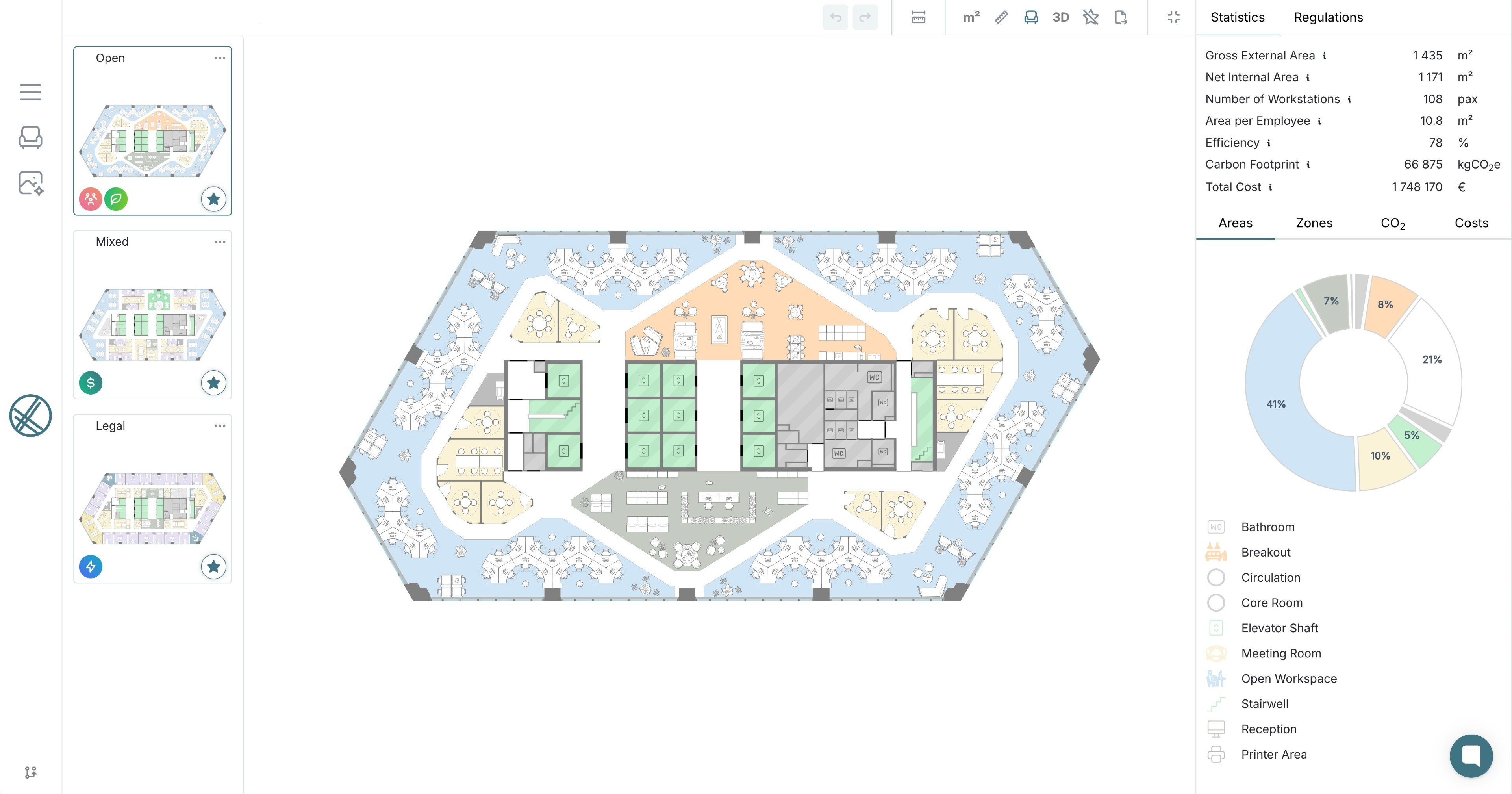
- laiout gives the committee validated, data-backed floor plan options, capacity, cost and carbon for every variant, alongside AI renders to see each one, so a tenant's own decision speed can match the market's pace.
European office demand isn't the problem. Savills' latest European Office Leasing Spotlight found take-up fell 6% year on year in H1 2026, not from weaker demand, but because occupiers are taking longer to validate cost assumptions before signing off.
- The best space is disappearing fast: Prime CBD vacancy across Europe sits at around 2%, and take-up in Dublin, London West End, Berlin and Munich is running 28 to 63% ahead of their five-year averages, according to Savills.
- New supply won't close the gap soon: Cushman & Wakefield project an 8.9 million sqm shortfall in Grade A European office space by 2028, even as Grade A vacancy has already tightened to 3.3%.
- Scarcity is pushing prices up too: Prime office occupier costs in major cities, London included, rose 5.3% year on year to Q2 2026, according to Savills' Global Occupier Markets report.
This isn't about rushing the decision, it's about speeding up validation, the same test fit modelling that replaces days of architect time with minutes, so committee judgement doesn't lag a market that's already moved on.
- Turn the brief into a live layout before the meeting is even booked: Upload the requirements brief as a PDF, image, DOCX or CSV and Brief Autofill populates the plan automatically, in multiple languages, cutting the slowest step to minutes.
- Compare every shortlisted floor under the same real numbers: Save Dublin, Munich and London as Favourites, then run each through different Cost Profiles to compare a standard fit-out against a premium one, so the committee weighs a genuine trade-off, not competing assumptions.
- Show the room the actual space, not a rendering from six weeks ago: Generate an AI Render straight from the 2D plan, then pull an Aerial Render from any angle, so a remote stakeholder sees the shortlisted floor as it will really look.
- Keep momentum once the room says yes: Share the layout as one interactive link for every reviewer, then hand the approved design into Revit as native elements or export a 3D DWG, so nothing is rebuilt from scratch.
Q: Does this replace the due diligence a European occupier's committee needs to do?
It supports that due diligence rather than replacing it, giving the committee something concrete and current to review, a validated layout, cost and visual, rather than a broker's summary and an estimate that's still a week away.
Q: How fast can a shortlisted floor plate actually be turned into something a stakeholder group can review?
Minutes, not weeks. Upload the floor plate, set headcount and room mix, and a compliant layout with live cost and capacity data generates immediately, ready to render and share the same day.
Q: Does this work across multiple cities and stakeholders at once?
Yes. As occupier decisions increasingly involve stakeholders across several European offices, sharing a layout as a live link means everyone reviews the same current version, wherever they're based.
Europe's tightening prime market isn't a reason for tenants to slow their scrutiny, it's a reason to speed up the parts of the process that don't need to be slow, the same discipline behind why speed wins in competitive leasing markets. The occupiers securing space in London West End, Munich, Berlin and Dublin right now aren't moving recklessly, they're the ones whose internal process can keep pace with a market that isn't waiting. Book a demo with laiout today and see how quickly your next shortlisted floor could be ready for your stakeholders to review.
- European office take-up fell 6% year on year in H1 2026, driven by longer decision cycles rather than weaker demand, according to Savills.
- Prime CBD vacancy across Europe sits near 2%, even as overall vacancy holds at 9.4%.
- Take-up in Dublin, London West End, Berlin and Munich is running 28 to 63% ahead of five-year H1 averages.
- Cushman & Wakefield project an 8.9 million sqm shortfall in Grade A European office space by 2028.
- Prime office occupier costs across major global cities rose 5.3% year on year to Q2 2026.
- laiout gives stakeholder groups a validated, visual layout in minutes, so internal review can move as fast as the market does.
- Spotlight: European Office Leasing – Q2 2026, Savills, August 2026.
- European Offices: Shrinking Supply, Cushman & Wakefield, 12 June 2026.
- Global Occupier Markets: Prime Office Costs – Q2 2026, Savills, August 2026.
Author: Theodore Harding, laiout
Get laiout News and Updates right in your inbox.

We're always open to hearing from talented people. If you don't see an open role that fits, send a speculative application to careers@laiout.co.Tell us what you'd bring and why laiout resonates with you.

Sign up to our newsletter


.svg)
.svg)


.svg)

