Materials, embodied carbon, and even financial value are discarded - only to be rebuilt from scratch at enormous environmental and economic cost.
The built environment accounts for a staggering 39% of global energy-related CO₂ emissions, according to the World Green Building Council. Yet despite growing awareness, too many redevelopment projects still begin with demolition. Materials, embodied carbon, and even financial value are discarded - only to be rebuilt from scratch at enormous environmental and economic cost.
But there’s another path. One that reuses, reimagines, and revitalizes what already exists, the foundation of how AI drives carbon-efficient office design.
Adaptive reuse is no longer a niche approach; it’s becoming a necessity. Reports such as Gensler’s Climate Action 2021: The Adaptive Reuse Revolution argue that keeping structures in use is one of the fastest and most impactful ways to reduce emissions. Every square meter that gets reused avoids the carbon footprint of demolition, transport, and reconstruction.
For landlords and brokers, this isn’t just about ESG - it’s about market value, the same logic behind turning the EPBD deadline into rental premiums. Tenants are increasingly seeking sustainable spaces that align with their own commitments, and regulations across Europe and North America are tightening on embodied carbon.
Sustainability may sound like a high-level strategy, but in practice, it starts at a surprisingly detailed level: the floor plan. The way a space is configured determines whether it can be reused efficiently or whether a full strip-out becomes “easier.”
Traditional floor planning processes often overlook this. They’re slow, rigid, and focused on standard configurations rather than maximizing what’s already there. As a result, the path of least resistance often becomes demolition.
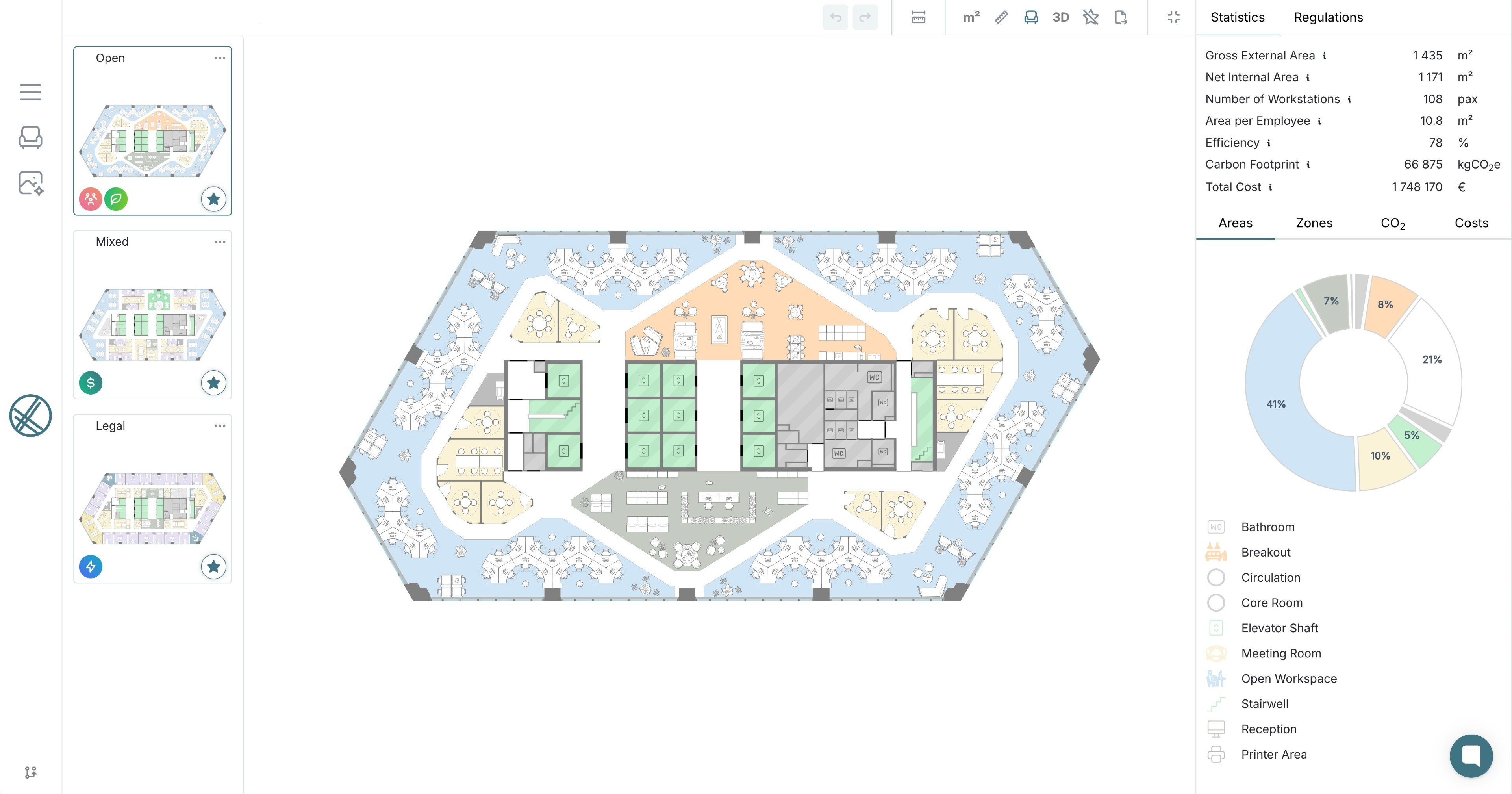
This is where AI-enabled tools make a difference. By generating layouts in seconds, they allow stakeholders to see multiple reuse-focused configurations instantly - without needing weeks of manual design.
With platforms like laiout, landlords, brokers, tenants, and architects can:
⚡ Unlock the potential of existing assets in minutes by generating test fits that make reuse practical.
🚀 Compare layouts instantly to see how existing structures can support modern workplace needs.
🌍 Reduce emissions by up to 40% compared to new builds by avoiding unnecessary demolition and construction.
By making reuse the easier option, AI changes the incentives: the fastest, most flexible, and most cost-effective plan is often also the most sustainable.
The future of sustainable real estate isn’t just about shiny new green buildings - it’s about the smart, thoughtful reuse of what we already have. Floor plans may not seem like the frontline of climate action, but they are where decisions about reuse or rebuild actually take shape.
The greenest building is the one that already exists. With the right tools, stakeholders can unlock its potential, cut emissions, and create spaces that serve both people and the planet.
Explore how laiout helps real estate teams turn reuse into reality - one floor plan at a time.
Get laiout News and Updates right in your inbox.

We're always open to hearing from talented people. If you don't see an open role that fits, send a speculative application to careers@laiout.co.Tell us what you'd bring and why laiout resonates with you.

Sign up to our newsletter


.svg)
.svg)


.svg)

