Run an occupied office or test fit a new one? A fair comparison of laiout and Kadence.
Updated October 2026. This comparison reflects publicly available information as of 22 October 2026.
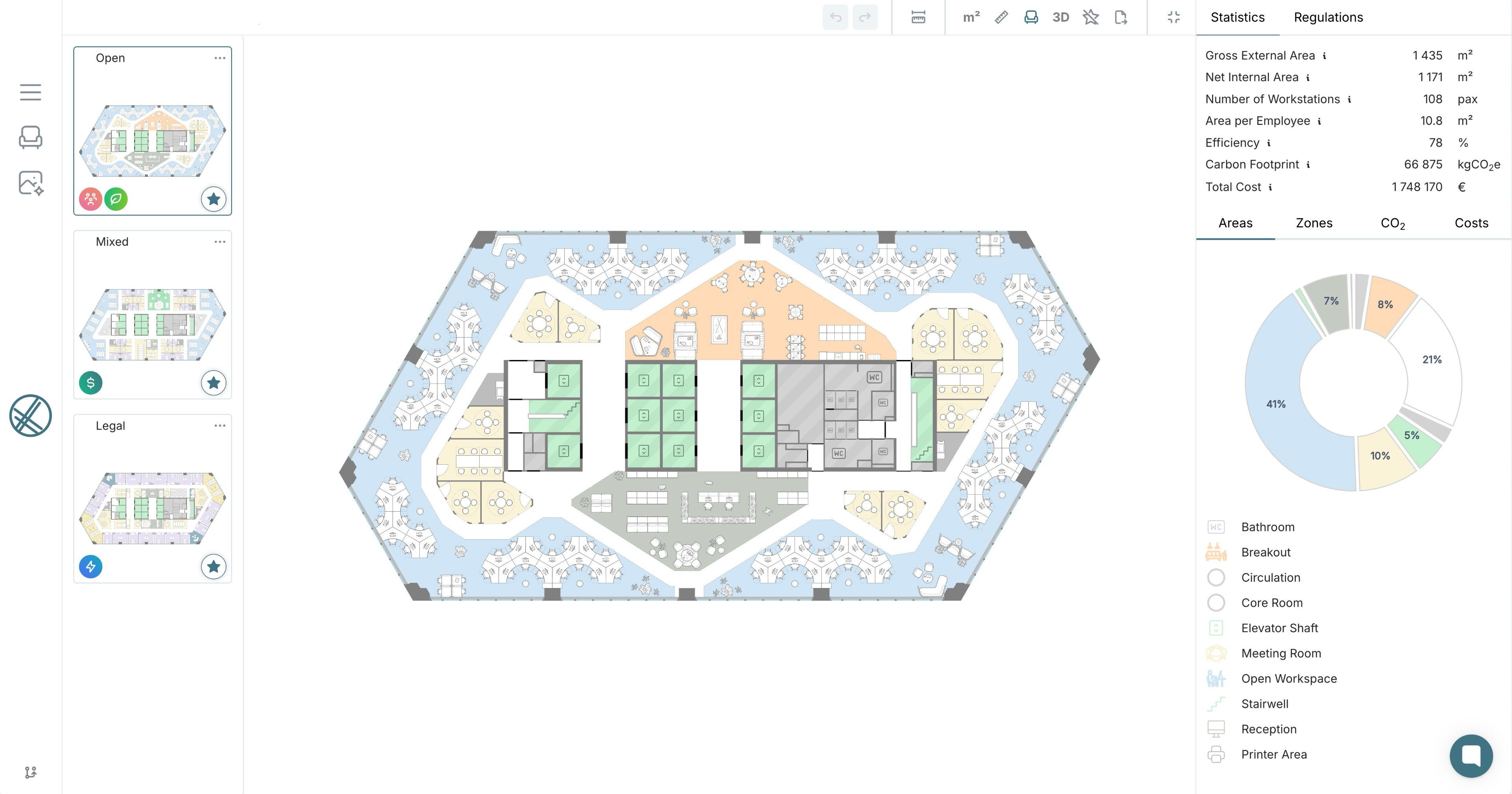
laiout is self-service AI test fit software that generates commercial office layouts in seconds, adjusts them live, exports them straight to Revit, CAD and PDF, and turns any design into AI static and video renders within minutes. Kadence is, per its own site, a workplace management platform for hybrid offices, covering desk and room booking, live occupancy data and, since April 2026, SpaceOps, an AI product for stack planning, seating plans and move scheduling. In our view, laiout is the stronger choice for generating the test fits that support a lease or fit-out decision, while Kadence fits occupiers who want to run and reorganise an office they already occupy using real usage data.
- Kadence and laiout both use AI to plan how people sit in an office, but they start from different questions. laiout generates and adjusts new layouts live in seconds for a leasing or fit-out decision, while Kadence uses booking and presence data to plan team allocations and moves inside an occupied workplace.
- In our view, laiout is the stronger choice for landlords, tenants, brokers and designers who need a test fit now, since live cost, carbon and capacity data, exports, and AI renders and videos within minutes are available from the first session. Kadence is the better fit for workplace teams that want occupancy insight, desk booking and move execution in one operating platform.
- The platforms meet in space planning, but at opposite ends of the lease, and some organisations will use both.
Kadence now offers AI space planning through SpaceOps, which is why the two appear in the same searches. Traditionally, a simple office test fit takes days to weeks from brief to finished plan, even though the drafting itself is only a few hours of architect time for a single floor plate, which is one reason leasing cycles run long. Fees run from a few hundred to several thousand dollars, and test fit agreements commonly range from $0.12 to $0.15 per square foot. Kadence and laiout both shorten the path from a floor plan to a decision, from different directions.
- Different questions: laiout asks what could fit on a floor, while Kadence asks how a workplace is really used and how to reorganise it, per its own site.
- Different data: laiout generates layouts from the floor plan and space requirements, whereas Kadence's SpaceOps uses booking and presence data from its WorkOps module, per its own site.
- Different buyers: laiout serves landlords, tenants, brokers, designers and flex operators, whereas Kadence's site names workplace leaders, with facilities, HR and IT teams.
- Built for: laiout serves landlords, tenants, brokers, designers and flex operators. Kadence targets workplace and real estate leaders, with facilities, HR and IT teams, per its own site.
- Core job: laiout generates optimised test fits and lets users adjust them live. Kadence describes SpaceOps as an AI agent that plans, models and executes workplace change, per its own site.
- Data behind the plan: laiout works from the floor plan and the brief. Kadence states that SpaceOps draws on booking, badge, Wi-Fi and check-in data to model occupancy without sensors, per its own site.
- Speed: laiout generates a layout in seconds. Kadence states that scenarios can be generated in minutes and that teams can model, plan and execute change in hours, not weeks, per its own site.
- Live metrics: laiout shows cost, carbon and capacity live, updating on every adjustment to the plan or design. Kadence lists scenario comparison across cost, desks, teams and floors, per its own site.
- Getting started: laiout is self-service, with onboarding typically completed in a single session. Kadence states that most teams are live on its WorkOps booking platform within days, with no specialist and no implementation project, per its own site.
- Visuals: laiout provides AI static and video renders within minutes (a premium add-on), plus 3D walkthroughs. Kadence lists floor plan wayfinding and search, and exports for stakeholder sign-off, per its own site.
- Sharing: laiout creates live shared links to a design that update automatically, so stakeholders can open and review the latest version without a CAD licence. Kadence lets approved plans be applied in the platform with desk assignments and facilities notifications, per its own site.
- Integrations and outputs: laiout exports to DWG, DXF, RVT, IFC, OBJ, PDF and CSV, and its Revit plugin brings the chosen layout back as native, editable Revit elements. Kadence lists integrations with calendars, chat, SSO, HR and service desk systems, plus a public REST API and webhooks, per its own site.
- Portfolio: laiout Hub stores a portfolio's floor plans and statistics in one place.
- Security: laiout is hosted on AWS in Europe (Stockholm), is ISO 27001 certified and SOC 2 Type 2 compliant, and offers SSO, role-based access and two-factor authentication. Kadence states SOC 2 Type II and Cyber Essentials, with US or EU data hosting, per its own site.
- A lease or fit-out decision is live: Generate a test fit and adjust it with the client in the room. This is the same logic behind why speed wins in competitive leasing markets.
- You are not yet in the space: Tenants, brokers and landlords test fit a floor plate before anyone has moved in, so there is no usage data to model yet.
- The whole deal team needs access: Landlords, tenants, brokers, designers and flex operators work from the same self-service platform, with onboarding typically completed in a single session.
- Capacity, cost and carbon sit beside every layout: laiout shows these metrics live and updates them on every adjustment to the plan or design, so trade-offs are visible during the conversation.
- Finished outputs are needed straight away: Export to DWG, DXF, RVT, IFC and OBJ the moment the layout is right, and generate AI static and video renders from the same design within minutes.
- You run an occupied workplace: Kadence combines desk and room booking, visitor management and live occupancy in one platform, per its own site.
- You want plans grounded in real usage: Per its own site, SpaceOps sizes team allocations from how floors are actually used, which a test fit generated from a floor plan and a brief does not draw on.
- You want to execute moves, not just plan them: Kadence lists move scheduling, conflict detection and applying approved plans in the platform, per its own site.
- Deep workplace system integrations matter: Kadence lists calendar, chat, SSO, HR and service desk integrations, per its own site. On security the two are level, since laiout is also ISO 27001 certified and SOC 2 Type 2 compliant.
- Where are you in the lease? Choosing, negotiating or fitting out a space points to laiout. Running and reorganising a space you already occupy points to Kadence.
- What data will drive the plan? A floor plan, a brief and live cost, carbon and capacity metrics point to laiout. Booking and presence data from your own workplace points to Kadence.
- What should come out? Layouts, renders, videos and CAD or Revit exports point to laiout. Seating assignments, scheduled moves and utilisation reporting point to Kadence.
Q: What is Kadence SpaceOps?
Kadence describes SpaceOps as an AI agent that plans, models and executes workplace change, launched in April 2026 within its workplace platform. Per its own site, it proposes team placements, compares scenarios, assigns seats on a floor plan and schedules moves, using booking and presence data from its WorkOps module. It is designed for offices that are already occupied, whereas laiout generates test fits for floor plates before and during a lease.
Q: Is Kadence or laiout better for office space planning?
In our view, laiout is the stronger choice for planning a new layout, because it generates and adjusts test fits live in seconds, with cost and carbon data, renders and Revit-ready exports. Kadence suits occupiers who want to reorganise an office they already use, based on real occupancy. Our guide to choosing an AI floor plan generator sets out how to weigh the options.
Q: Does Kadence generate test fits like laiout?
Kadence describes SpaceOps as AI that proposes team placements, assigns people to seats on a floor plan and schedules moves, using its own occupancy data. That is workplace allocation rather than a test fit of a prospective floor plate. laiout generates optimised test fits in seconds and lets the user adjust them live.
Q: What are alternatives to Kadence for space planning?
The right alternative depends on the job. laiout is built for instant, self-service test fits that landlords, tenants, brokers, designers and flex operators generate, adjust and export themselves. Other platforms focus on desk booking, workplace analytics or building data, so it helps to start with the decision you need to support. Our guide to AI test fit software covers five criteria for comparing them. For a platform aimed at corporate occupiers, see how laiout compares with Saltmine.
Q: Is Kadence or laiout better for tenants?
Tenants searching for or negotiating a space lean towards laiout, which lets them see how a floor plate could work before they sign, with renders and videos to share internally. Tenants already in a space who want to manage desks and reorganise teams may prefer Kadence, and some will use both.
Q: How much does Kadence cost?
Kadence does not list prices on the pages we reviewed. Its site says pricing is based on the size of the organisation and the features needed, with a demo or custom quote. Check its site for current details.
Q: Can laiout designs be shared with stakeholders who do not have CAD software?
Yes. laiout creates live shared links to a design that update automatically, so stakeholders can open and review the latest version without a CAD licence. Kadence takes a different approach, with exports for stakeholder sign-off and plans applied inside its platform, per its own site.
Q: Can a team use both laiout and Kadence?
Yes. A tenant can use laiout to test fit and choose a new space, then use Kadence to manage desks, bookings and moves once the team is in.
In our view, laiout is the stronger overall choice for the decisions that come before and around a lease. It is live, self-service and usable by the whole deal team, and puts capacity, cost and carbon data and Revit-ready exports in your hands straight away, with AI static and video renders following within minutes. Kadence earns its place for occupiers who want to run an existing workplace on real usage data, and many will sensibly use both.
If the next step is a live conversation, book a demo with laiout today and see a test fit generated, adjusted and exported in front of you.
- laiout generates and adjusts test fits live in seconds, while Kadence's SpaceOps plans team allocations and moves from booking and presence data.
- A traditional architect-led test fit can take days to weeks to turn around and can cost from a few hundred to several thousand dollars.
- Kadence combines desk and room booking, live occupancy, and AI stack planning, seating and move scheduling, per its own site.
- laiout adds live capacity, cost and carbon data, AI static and video renders, 3D walkthroughs and exports to DWG, DXF, RVT, IFC, OBJ, PDF and CSV.
- Kadence is built for occupied workplaces, while laiout supports the decisions made before and around a lease.
- In our view, laiout is the stronger choice for test fits and leasing decisions, and Kadence for running an occupied workplace.
- What Is a Test Fit in Commercial Real Estate? How Developers Use Them, Build, March 2026.
- Why Tenants Should Use A Test Fit, Park Real Estate Advisors.
Author: Theodore Harding, laiout
Get laiout News and Updates right in your inbox.

We're always open to hearing from talented people. If you don't see an open role that fits, send a speculative application to careers@laiout.co.Tell us what you'd bring and why laiout resonates with you.

Sign up to our newsletter


