AI companies now make up 34% of London tech office demand. Here is how flex operators retain fast-scaling AI members before they outgrow their floor.
- AI companies now account for 34% of London tech office demand, and 75% of the sector's leading startups operate from flexible workspaces, making them the fastest-growing and most demanding member segment.
- AI firms scale headcount unpredictably and typically outgrow their current floor configuration within 12 to 18 months, creating a structural retention risk for operators who cannot respond quickly.
- laiout generates a reconfigured test fit for any floor plate in minutes, giving operators a credible, visual layout to present before a scaling member starts looking elsewhere.
AI firms have become the defining demand driver for flexible workspace, part of the same shift that is helping flex operators win enterprise contracts. New CBRE research on London's office market found that AI companies accounted for 34% of London tech office demand in 2025, up from just 4% a decade ago. Of the 100 leading AI startups analysed, 75 currently operate from flexible workspaces and only nine occupy conventional offices. That concentration inside flex is not incidental. It reflects a deliberate choice driven by speed, optionality, and the inability to predict headcount 12 months out.
- The velocity problem is structural, and it rewards operators who move quickly, the same lesson behind why demand is real and speed is delivering: Industry research from April 2026 found that AI companies scale at a pace that makes long-term real estate planning functionally impossible, which is precisely why they choose flex. A 15-person team can become 45 people within a year of signing. That is not a special case; it is the operating model.
- Most operators are not set up to respond in time, which also shapes how they pitch landlords on management agreements: Floor configurations are fixed at fit-out and rarely revisited until a lease expires or a full refurbishment is planned. When a member's headcount triples, the operator's standard response is a meeting, a designer brief, and a wait measured in weeks. That window is long enough for the member to sign with a competitor.
- The retention risk is compounding: Flexible offices now account for roughly 12% of the total Central London office market, according to CBRE's European Flex Office Market Update. As more AI firms enter and scale within that inventory, and as flex growth pushes beyond the central business district, the operators who can match their pace will capture a disproportionate share of the highest-value long-term contracts.
Before laiout, the conversation with a scaling member typically went: request received, designer briefed, two weeks later, a layout. By then, the member has toured three alternatives. With laiout, an operator can present a reconfigured floor plan in the same conversation. laiout has been used to plan over 30 million square metres of commercial space globally.
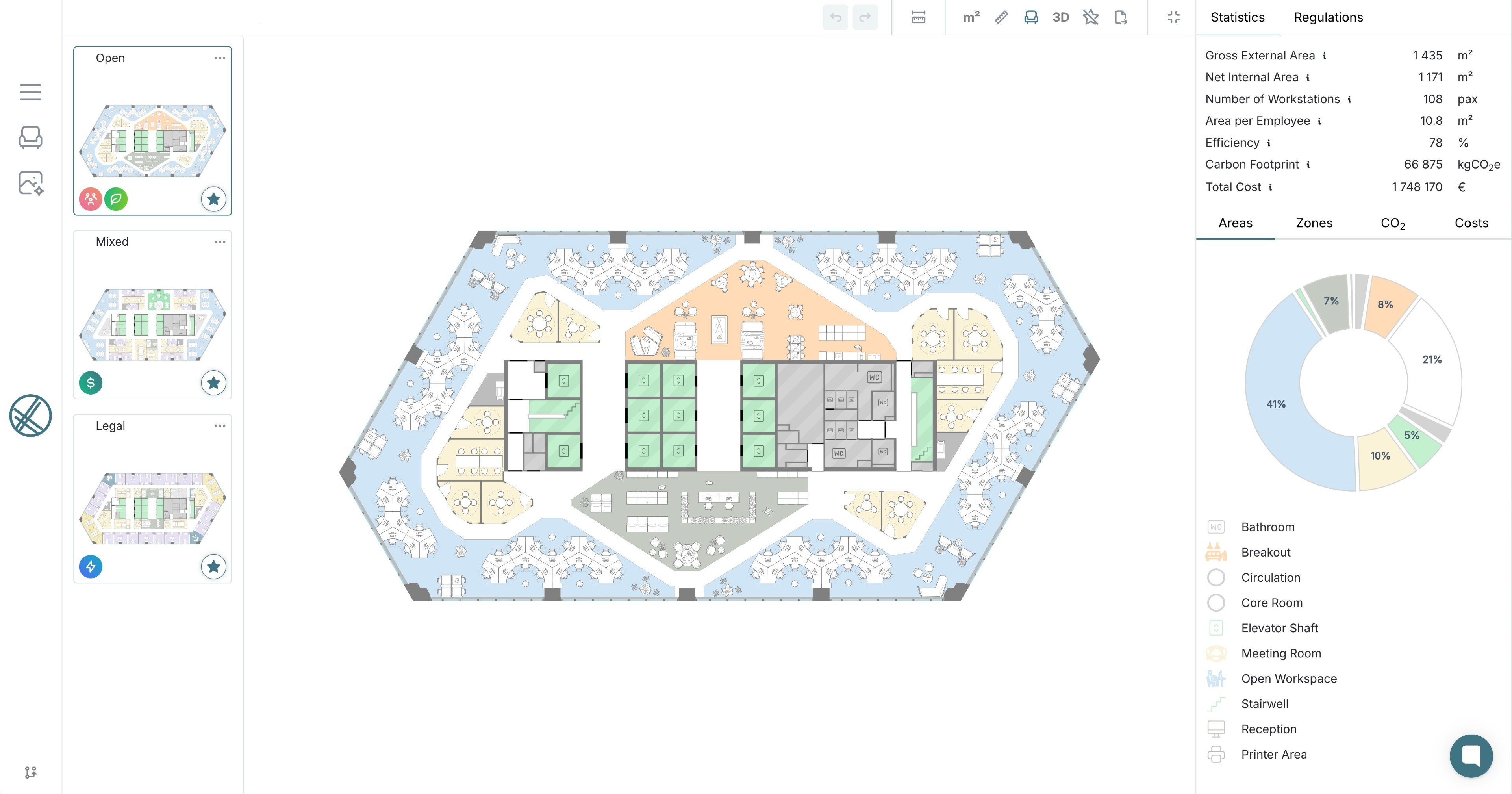
- Reconfigure any floor plate in minutes: Upload your existing floor plan, set the parameters for the member's new headcount and product requirements, and laiout generates an optimised layout immediately with capacity, area, and density data attached. The response becomes "here is what your team looks like on floor three" rather than "we will come back to you."
- Compare layout options with the member using live analytics: laiout's analytics view lets operators walk a scaling member through different configuration scenarios, with headcount capacity, desk density, and area allocation shown side by side. The comparison happens in the room, turning a retention conversation into a collaborative planning session.
- Generate photorealistic AI renders in the member's look and feel: Every layout can be rendered to a client-ready visual standard within laiout, tailored to the member's brand and interior preferences. A fast-growing AI firm can see their team's next space before any commitment is made, removing the uncertainty that typically delays a decision.
Q: Do I need a CAD file to use laiout, or will a PDF floor plan work?
laiout accepts PDF uploads as well as DWG, DXF, and IFC files, so most operators can start with whatever format they have on file.
Q: How accurately does the reconfigured layout reflect our actual floor plate?
laiout generates layouts against your specific uploaded floor plate, not a generic template. The output reflects your actual dimensions, structural constraints, and core positions, so it is spatially accurate and immediately presentable.
Q: Does producing a reconfigured layout in laiout commit the operator to a fit-out?
No. The layout is a planning and retention tool. Most operators use it to validate demand and hold a productive conversation with a scaling member before committing any capital to physical changes.
Q: Will laiout work alongside our existing design and fit-out partners?
Yes. Outputs export to DXF, DWG, IFC, and PDF, slotting directly into any existing workflow. laiout is the fast front-end assessment layer; your design partners take it from there.
AI companies chose flexible space because it removes the friction of long-term real estate decisions. When a growth request reintroduces that same friction, the logic of staying starts to weaken. As Natasha Guerra, CEO of Runway East, noted in a recent expansion announcement, demand in the sector has fundamentally shifted, and operators who can meet members where they are will continue to win. The floor plate reconfiguration conversation is the moment that tests whether an operator is set up to do that.
Book a demo with laiout today and find out how quickly you can respond to your next member growth conversation.
- AI companies accounted for 34% of London tech office demand in 2025, up from 4% a decade ago, making them the fastest-growing source of flex membership by volume.
- 75 of the 100 leading AI startups in London operate from flexible workspaces, representing a dense and active pipeline of growth events for operators.
- AI firms scale headcount unpredictably, often needing a different floor configuration within 12 to 18 months of signing, which creates a structural retention challenge for operators with slow reconfiguration processes.
- Flexible offices account for roughly 12% of total Central London office stock, meaning the AI tenant opportunity is large and competition to retain high-growth members is intensifying.
- The gap between a member's growth request and an operator's visual response is where retention is won or lost. Standard design briefing timelines run to weeks.
- laiout generates a reconfigured, spatially accurate test fit for any floor plate in minutes, calibrated against over 30 million square metres of commercial space planning globally.
Get laiout News and Updates right in your inbox.

We're always open to hearing from talented people. If you don't see an open role that fits, send a speculative application to careers@laiout.co.Tell us what you'd bring and why laiout resonates with you.

Sign up to our newsletter


.svg)
.svg)


.svg)

