Design firm satisfaction with AI has hit 84%. Here's why adoption concentrates where judgement stays firmly in charge.
- Design firms are now among the most satisfied AI adopters in construction: satisfaction climbed from 70% to 84% in a year, per Houzz, while RIBA's own 2026 survey puts UK adoption at 74%, up from 41% two years ago.
- Both surveys agree on where that trust sits: pre-project concept and visualisation, not final judgement, where 82% of design firms and 56% of RIBA respondents already use AI.
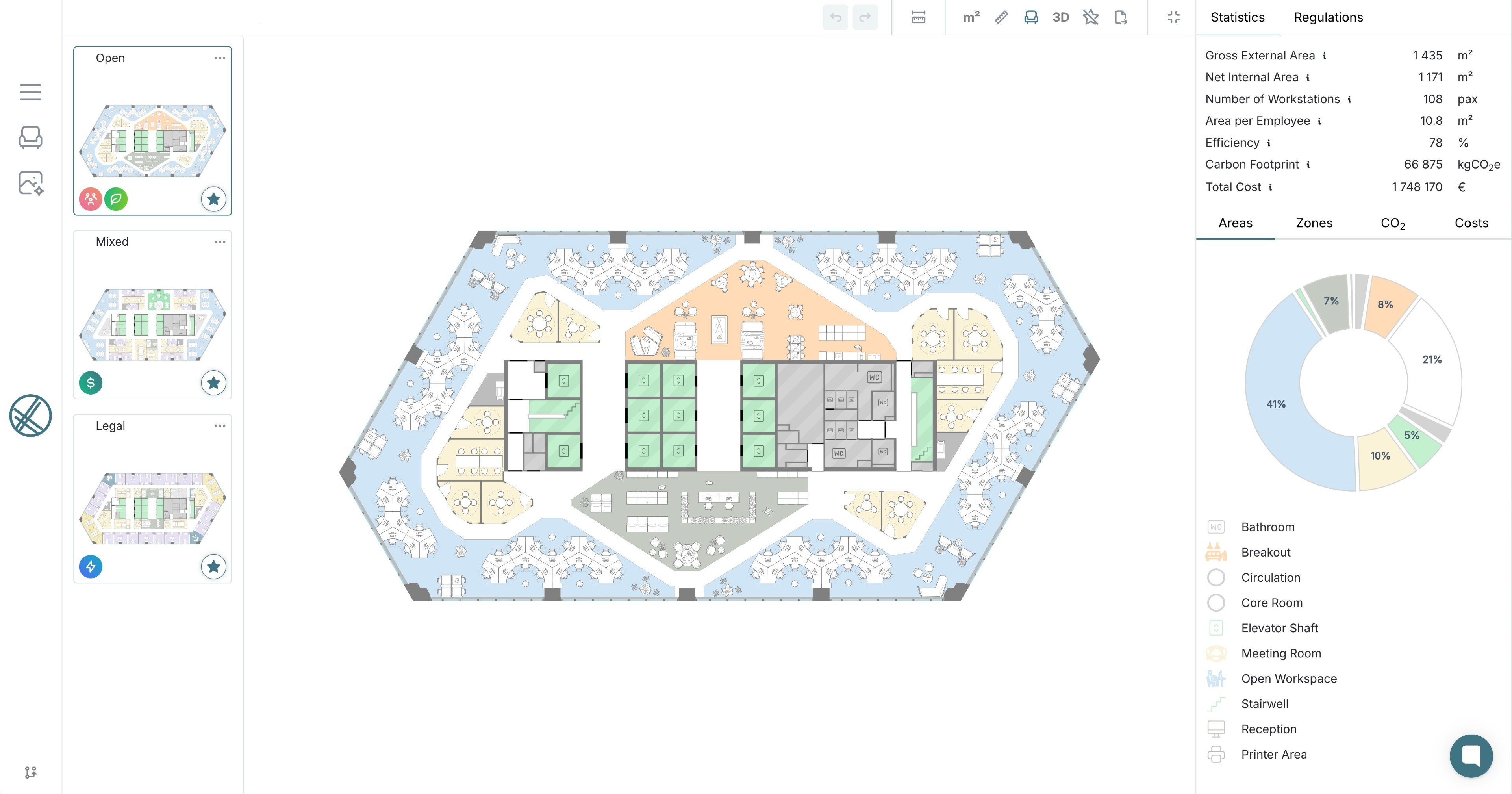
- laiout sits at precisely that stage, generating credible, code-compliant concepts in minutes while leaving every layout open for a designer to shape, so adoption and satisfaction climb together instead of trading off.
The fear that adopting AI means trading away craft doesn't match what firms using it are reporting. Houzz's 2026 State of AI in Construction and Design report found design firm AI use has grown to 39%, up 8 points from 2025, with satisfaction climbing from 70% to 84% over the same period, and firms using AI saving an average of 3.6 hours a week.
- UK data tells the same story, at greater scale. RIBA's 2026 AI survey found 74% of practices now use AI on at least some projects, up from 59% last year and just 41% in 2024, with adoption reaching 31% of practices using it on every or most projects.
- Adoption is concentrated exactly where you'd want it to be. 82% of design firms in the Houzz report use AI specifically for pre-project visuals and concept development, and RIBA found 56% of AI users apply it to early-stage design visualisation, the single most common use, alongside 40% for compliance checking.
- The profession hasn't stopped believing creativity is theirs. Despite rising adoption, 77% of RIBA respondents still agree that AI can never replace human creativity, and 73% of AI users report a productivity improvement, so the two aren't actually in tension.
None of this means every AI tool earns that trust equally. Separate reporting this month found interior designers fielding client-generated concepts from consumer AI tools with dining chairs missing legs and kitchens that ignored building codes entirely. The gap isn't AI itself, it's whether the tool was ever built to understand a real, compliant floor plate rather than just an image.
- Compete on optionality without adding headcount: Produce multiple costed concept directions in the time a manual process makes one, the same discipline behind why small firms are holding their ground against consolidation pressure.
- Spend the time you get back on the design itself: RIBA found 44% of AI-using practices now spend more time on creative, high-value work, the hours a compliant first draft used to cost in manual redraws.
- Take a concept from 2D to a build-ready model: Turn any layout into a 3D model in around four seconds, generate photorealistic AI renders from multiple angles, then send the finished design into laiout for Revit, where it returns as native, editable elements rather than throwaway geometry.
Q: Will AI replace architects?
The adoption data itself argues against it. RIBA found that even as AI use has tripled since 2024, 77% of architects still hold that AI can never replace human creativity, because concept-stage AI produces options to choose from, not decisions the designer no longer makes.
Q: How is this different from a consumer AI tool like ChatGPT?
A general-purpose image or chat tool has no idea what a building code requires, which is why designers are reporting furniture and layout errors from client-generated concepts. laiout generates from an actual floor plate with compliance built in, so the starting point is buildable, not just plausible-looking.
Q: How fast can a firm actually produce a client-ready concept this way?
Minutes, from an uploaded floor plate or brief. Comparing two or three concept directions for the same brief typically takes under an hour.
Satisfaction with AI in design isn't rising despite firms protecting their judgement, it's rising because they are. The practices in both surveys reporting the biggest productivity gains are the same ones keeping AI at the concept and visualisation stage and holding the line that creativity stays theirs. That's not a compromise, it's what the data says actually works.
Book a demo with laiout today and see what a compliant first concept looks like in the time it takes to describe the brief.
- Design firm AI adoption reached 39% globally in 2026, up 8 points from 2025, with satisfaction climbing from 70% to 84%, per Houzz.
- RIBA's 2026 survey found 74% of UK practices now use AI on at least some projects, up from 59% in 2025 and 41% in 2024.
- 82% of design firms use AI specifically for pre-project visuals, and RIBA found 56% of AI users apply it to early-stage visualisation, the most common use case.
- 73% of RIBA respondents using AI report a genuine productivity improvement, and 57% report a positive return on investment.
- Despite rising adoption, 77% of RIBA respondents still agree AI can never replace human creativity.
- laiout operates at exactly the concept and visualisation stage where adoption and satisfaction are both highest, generating compliant layouts in minutes while leaving every decision open for a designer to shape.
- AI adoption charges ahead in AEC industry, Building Design + Construction, citing Houzz's 2026 State of AI in Construction and Design report, 8 September 2026.
- RIBA AI Report 2026, Royal Institute of British Architects.
- Can AI be your interior designer? Not quite, but it can act as an assistant, Boston.com, 10 September 2026.
Author: Theodore Harding, laiout
Get laiout News and Updates right in your inbox.

We're always open to hearing from talented people. If you don't see an open role that fits, send a speculative application to careers@laiout.co.Tell us what you'd bring and why laiout resonates with you.

Sign up to our newsletter


.svg)
.svg)


.svg)

