Required office time is rising but attendance barely is. Here is why the layout is worth examining before the next policy change.
- Required in-office time has risen significantly across major employers, but actual attendance has increased by only 1 to 3%, a gap that is prompting a closer look at the workspace itself.
- Research consistently finds that open-plan layouts are a leading reason employees choose to work from home, with noise cited as the strongest predictor of poor workplace performance.
- Before revisiting policy, a reconfigured test fit against real attendance patterns can reveal whether the layout is supporting the hybrid model or working against it.
A pattern is emerging across office occupancy research that is worth sitting with. Required in-office time climbed 12% between early 2024 and 2025, but actual attendance increased by only 1 to 3%. For organisations that have invested in policy enforcement, that gap is a useful prompt to ask what else might be influencing the numbers.
The answer that keeps surfacing in the research is the layout itself.
- Open-plan floors are not neutral. Fewer than one in three employees believe their open-plan office helps them do their best work, with noise identified as the statistically strongest predictor of poor workplace performance, according to Leesman's workplace research. For hybrid workers attending two or three days a week, the days they come in are often the days they most need focused, uninterrupted work. An open floor that cannot accommodate that becomes a reason to stay home rather than a reason to come in.
- The space mix is not keeping pace with how work has changed. 91% of employees say they would attend the office more often if the space was designed to include more quiet working areas. That is a layout question as much as a policy question.
- Desk-sharing ratios set without reference to real attendance patterns create their own problems. Ratios set too aggressively lead to what researchers call "desk anxiety," where employees stop attending because they are not confident a suitable workspace will be available when they arrive. Stricter attendance requirements applied to an under-configured floor can compound the problem they are intended to solve.
Most tenants' current floor plans were configured before hybrid attendance patterns stabilised. The brief that informed the original fit-out was written against different assumptions, and the space often reflects that. laiout has been used to plan over 30 million square metres of commercial space globally.
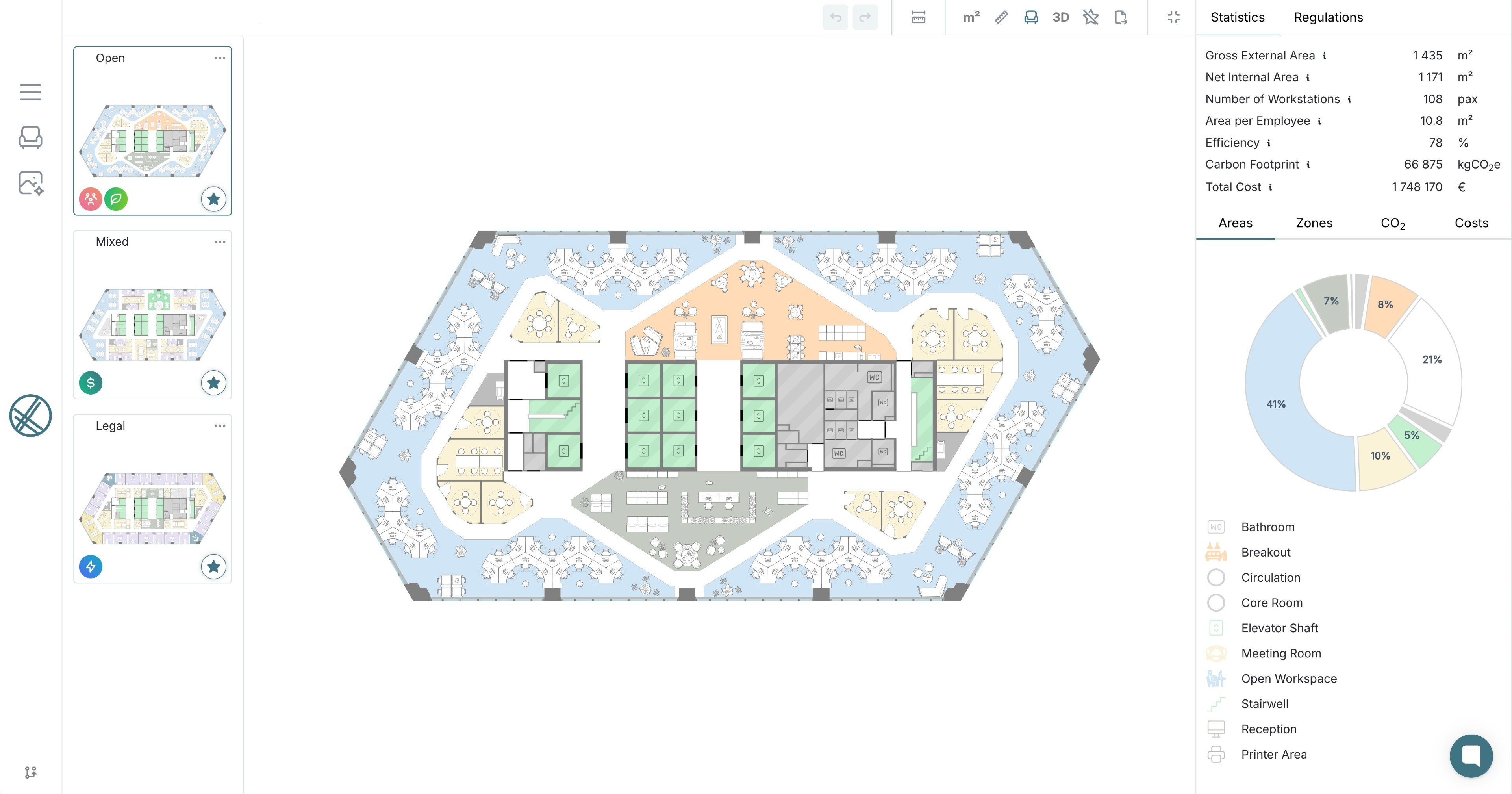
- Generate a reconfigured test fit against real attendance parameters: Upload your existing floor plan, set the parameters based on how your team actually attends rather than total headcount, and laiout produces an optimised layout with area allocations and capacity data. The output shows clearly whether the current space mix supports your hybrid model or is working against it.
- Model different zone ratios before committing to any changes: laiout's analytics view lets you compare the capacity and density implications of different splits between focus space, collaboration zones, and bookable quiet areas, side by side. The question of whether the layout supports the way people work becomes answerable before any capital is committed.
- Export and visualise for internal sign-off: Every laiout output is available in PDF, DXF, DWG, and IFC, making it straightforward to bring a reconfigured layout brief into conversations with fit-out partners or internal stakeholders. The same plan can be explored as a 3D model directly within laiout, and rendered to a photorealistic standard using AI, so decision-makers can see exactly what a reconfigured space looks like before any physical changes begin.
Q: How do I know whether the attendance gap in our office is a layout issue or something else?
A useful starting point is whether attendance varies meaningfully by role or team. Roles that require focused individual work and are placed in open, high-traffic zones tend to show lower attendance than those with access to quieter areas. If the pattern maps to the floor plan, the layout is worth examining.
Q: Does addressing a layout issue mean a full fit-out?
Not necessarily. Many effective reconfigurations involve zone redistribution rather than construction, shifting where focus and collaborative work happen, adjusting desk-sharing ratios, and adding bookable quiet areas. laiout models these scenarios against your existing floor plate before any physical changes begin.
Q: Will laiout work with the floor plan format we already have?
laiout accepts PDF uploads as well as DWG, DXF, and IFC files, so most tenants can start with whatever format is already on file.
Policy and layout are not competing levers. But the organisations finding the most traction on attendance are the ones that have looked honestly at whether the space justifies the commute, and made changes accordingly. US office utilisation retreated to 67% of pre-pandemic levels in early 2026, reversing gains made in 2025 when attendance had reached 75%, suggesting that enforcement alone is not enough to sustain momentum.
The floor plan is not a fixed constraint. It is one of the most direct variables available, and it is worth understanding what it is currently configured for before deciding what comes next.
Book a demo with laiout today and find out whether your current layout is set up for the way your team actually works.
- Required in-office time rose 12% between 2024 and 2025 while actual attendance increased by just 1 to 3%, a gap that points beyond policy toward the workspace experience itself.
- Fewer than one in three employees believe their open-plan office supports their best work, with noise identified as the strongest predictor of poor workplace performance across Leesman's research base.
- 91% of employees say they would attend the office more often if the space included more quiet working areas, making layout configuration a more direct lever than attendance enforcement alone.
- Desk-sharing ratios that are not calibrated to real attendance patterns can create desk anxiety that actively suppresses the attendance employers are trying to increase.
- US office utilisation retreated to 67% of pre-pandemic levels in early 2026 despite tighter enforcement, indicating that the physical environment is shaping attendance in ways that policy alone cannot override.
- laiout generates a reconfigured test fit against real attendance parameters in minutes, calibrated against over 30 million square metres of commercial space planning globally.
Get laiout News and Updates right in your inbox.

We're always open to hearing from talented people. If you don't see an open role that fits, send a speculative application to careers@laiout.co.Tell us what you'd bring and why laiout resonates with you.

Sign up to our newsletter


.svg)
.svg)


.svg)

