Employee engagement hit a 5-year low despite rising attendance. The real question is whether layouts match how people actually work.
- Global employee engagement dropped to 20% in 2025, its lowest since 2020, costing an estimated $10 trillion in lost productivity, even as office attendance reached post-pandemic highs.
- Attendance is up but engagement is down, which means the problem is not whether people are in the building but whether the space supports how they actually work.
- laiout lets occupiers test spatial configurations in minutes, so CRE teams can make the case for reconfiguration with evidence rather than assumption.
Gallup's 2026 State of the Global Workplace report, published in April 2026, found that global employee engagement fell to 20% in 2025, down for the second consecutive year and the lowest level since 2020. 64% of employees are not engaged. No region in the world saw an increase. Gallup estimates the productivity cost at $10 trillion globally.
- Attendance solved. Engagement not: CBRE's 2026 Global Workplace Occupancy Insights show that building utilisation jumped to 53% in 2025, up from 38% the year before, and peak utilisation hit 80%. People are coming back. But Gallup's data shows they are less engaged when they do come in, even as building utilisation hits its highest level since 2020.
- The layout is the variable most organisations have not revisited: Most offices are still configured for pre-pandemic work patterns. Yet hybrid attendance has fundamentally changed what people need from a building on any given day. Manager engagement alone has dropped nine points since 2022, and Gallup attributes this partly to environments that do not support the shifting demands of hybrid leadership.
- Reconfiguration is a planning problem, not a design one: The barrier to improving an underperforming layout is rarely budget or ambition. It is the inability to test what a different configuration would actually look like, how many people it would serve, and what it would cost, without commissioning a full design exercise.
The answer to falling engagement is not another attendance mandate. It is a layout that reflects how people actually work now. laiout gives CRE teams the tools to test that hypothesis before committing budget.
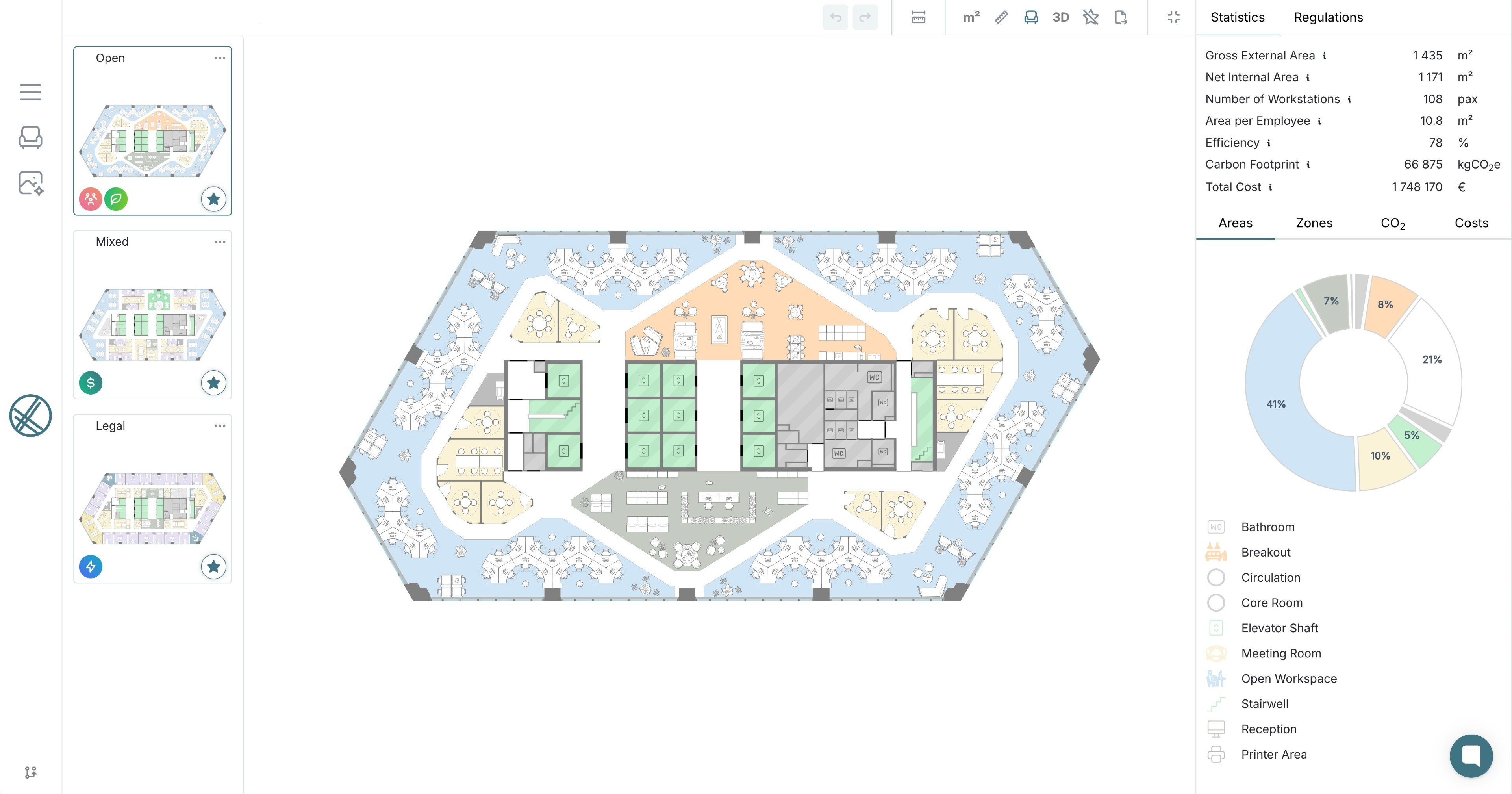
- Generate layouts around how your team actually works: Set your spatial brief and laiout generates multiple compliant options in seconds. The new Analytics View lets you compare configurations side by side with live capacity, efficiency, and area-per-employee data.
- Build the business case visually, not verbally: Every layout produces AI-rendered visuals, a 3D walkthrough, and a shareable link. When the CFO asks what a reconfigured floor looks like, the answer is a photorealistic render, not a slide deck.
- Quantify the cost of doing nothing: Each configuration comes with live fit-out cost estimates, carbon benchmarks, and a bill of quantities. Compare the status quo against alternatives and show leadership exactly what inaction costs.
Q: Our team is back in the office three days a week but the space still feels wrong. Where do we start?
Start by testing your current layout against your actual attendance patterns. laiout can generate alternative configurations for the same floor plate in seconds, showing how a different zone mix or desk ratio changes capacity and cost.
Q: Does laiout replace the workplace consultant?
No. laiout gives CRE teams the ability to run internal feasibility before engaging consultants, so the brief is sharper, the scope is clearer, and external spend is directed at design and strategy rather than spatial validation.
Q: Can we test a reconfiguration across multiple floors or buildings?
Yes. laiout supports multi-floor generation and portfolio-level planning, with localised building regulations applied automatically across 36+ countries.
Attendance mandates got people back into buildings. The next challenge is making those buildings worth coming to. That requires spatial evidence, not guesswork: real data on what configurations support focus, collaboration, and the hybrid patterns teams have settled into. Book a demo with laiout today and start designing an office people actually want to use.
- Global employee engagement fell to 20% in 2025, its lowest since 2020, costing an estimated $10 trillion in lost productivity.
- Office attendance has recovered strongly, with building utilisation reaching 53% and peak utilisation hitting 80%, but engagement has moved in the opposite direction.
- 64% of employees are not engaged at work, and manager engagement has dropped nine points since 2022.
- Most offices are still configured for pre-pandemic work patterns that no longer match how hybrid teams use space.
- laiout's Analytics View, AI renders, and live cost data let occupiers test and visualise reconfiguration options in minutes, with the evidence to justify the change internally.
- Closing the engagement gap starts with spatial evidence, not another attendance policy.
Get laiout News and Updates right in your inbox.

We're always open to hearing from talented people. If you don't see an open role that fits, send a speculative application to careers@laiout.co.Tell us what you'd bring and why laiout resonates with you.

Sign up to our newsletter


.svg)
.svg)


.svg)

