A global survey of nearly 800 architects confirms AI is saving design firms time. But the test-fit phase remains manual, and that is where projects are won.
- A global survey of nearly 800 architects finds 86% say AI saves them time, but gains are concentrated in concept renders and image generation, not space planning.
- Test fitting, the phase where a commercial designer proves a floor plate works against a live brief, remains largely manual and is the primary constraint on how many projects a firm can pursue at once.
- laiout, among the best AI space planning tools for commercial designers, automates commercial test fitting for architects and designers, compressing the process from days to minutes, with outputs that feed directly back into existing CAD and BIM workflows.
A global survey of nearly 800 architects published this week confirms AI adoption is real, growing, and broadly satisfying. More than half of those using AI tools are saving at least five hours per week. For firms using AI-assisted video and rendering tools, some are reclaiming over fifteen hours weekly. The numbers are compelling. The pattern behind them is worth examining closely.
- The gains sit in one phase: AI use in architecture clusters heavily in concept imagery, visualisation, and asset generation. These tasks are fast to iterate and well-suited to current AI capabilities, which is part of why generative tools so often fail architects on real spatial work. The harder analytical work of translating a live brief against a real floor plate has not kept pace.
- Test fitting remains manual: A recent review of operational bottlenecks across UK architecture practices confirms that preliminary spatial work, including test fits, remains among the most time-intensive and under-automated activities in the profession. Layouts are still built line by line, for projects that may not convert.
- Integration gaps are slowing the next wave: The latest findings from the Chaos and Architizer research series identify output accuracy and workflow integration as the primary reasons AI has not moved beyond visualisation into technically demanding stages. Commercial space planning sits squarely in that gap.
The test-fit bottleneck sits upstream of visualisation: between receiving a brief and having something credible to present. laiout closes that gap.
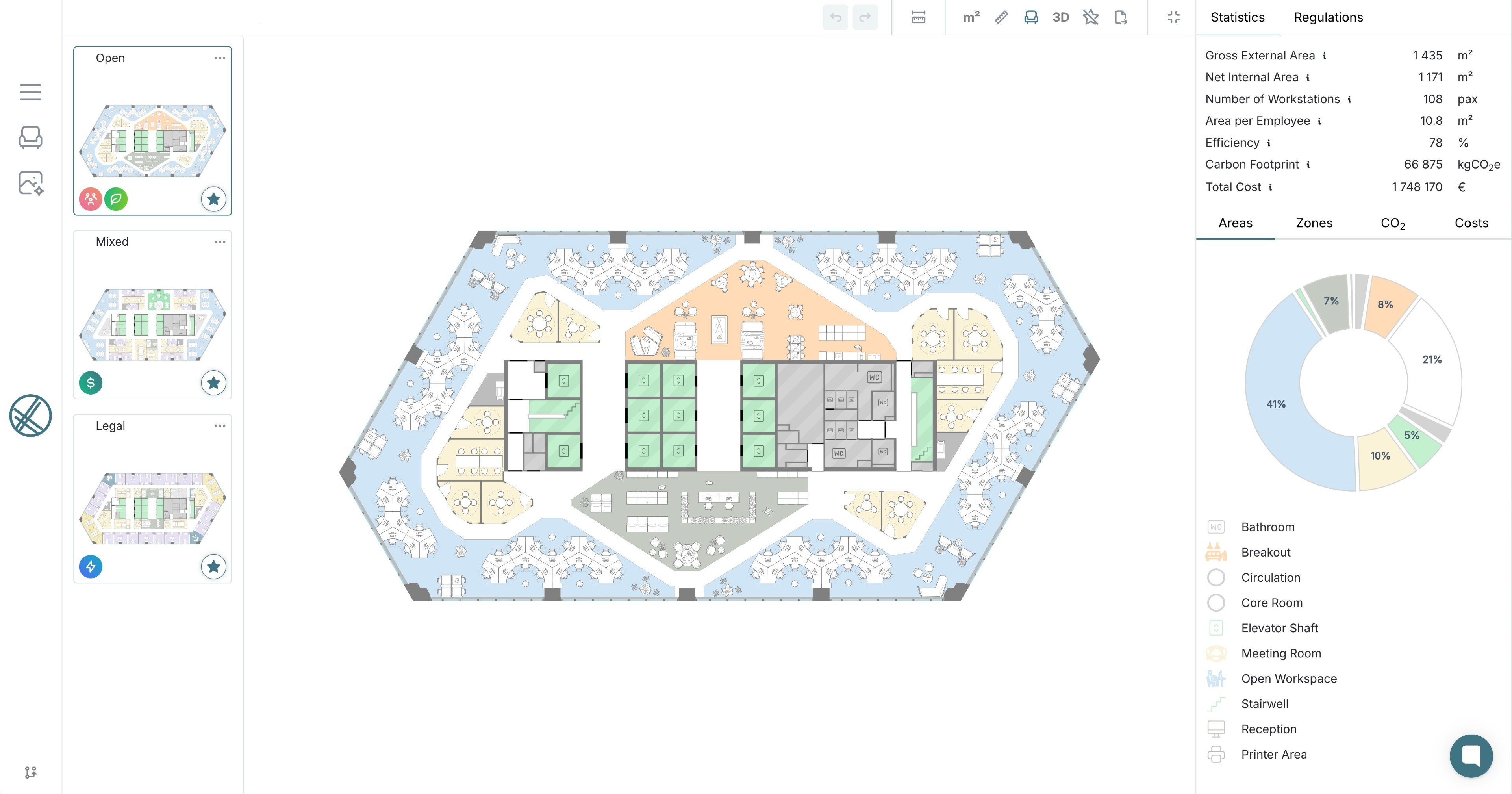
- Generate open-plan, cellular, and hybrid configurations against the same floor plate simultaneously: laiout reads bay depths, core positions, and structural grids to produce spatially coherent layout options in parallel. Designers compare programme performance across typologies before a single line is drawn in CAD.
- Arrive at the first client meeting with schemes built from the building's real geometry: laiout produces test fits that respect the actual constraints of the floor plate, including circulation logic and structural thresholds. The design conversation starts from a credible spatial foundation.
- Take outputs directly back into your existing tools: Once a layout direction is confirmed, laiout plans export in standard formats compatible with CAD and BIM workflows. Designers move from generated scheme to detailed design without rebuilding the spatial foundation from scratch.
Q: A client has sent over an AI-generated concept layout as their brief. How does laiout help me respond with something architecturally credible?
Input the actual floor plate and the client's programme into laiout and generate spatially accurate configurations built around the real constraints of the building. That translation from rough AI concept to viable scheme is where design expertise leads.
Q: Does laiout work across different building types and geographies?
laiout has supported over 30 million square feet of commercial space planning across more than 36 countries, covering office, flex, and co-working environments.
Q: Does laiout replace CAD or BIM tools?
No. laiout generates the spatial foundation and exports it back into your workflow. It removes the manual groundwork, not the design process.
Three in four architects plan to increase their use of AI over the next twelve months. If that growth stays concentrated in visualisation, the test-fit phase will remain the highest-cost, most speculative, and most manual part of the commercial design workflow.
Designers who bring AI into spatial planning change what they can credibly offer at pitch stage, and how many live projects they can pursue simultaneously.
- A survey of nearly 800 architects published 31 March 2026 finds 86% report AI saves them time, with more than half saving at least five hours per week.
- Productivity gains concentrate in concept visualisation. Commercial test fitting and space planning remain largely manual.
- Preliminary test fitting is typically speculative and unpaid, creating a sunk cost that scales with every pitch a firm pursues.
- 74% of architects plan to increase AI use in the next twelve months, but integration gaps are slowing adoption beyond the visualisation phase.
- laiout generates commercial test fits from a live brief in minutes and exports plans in formats compatible with existing CAD and BIM workflows.
- Designers using laiout can test open-plan, cellular, and hybrid configurations against the actual floor plate before opening CAD.
Get laiout News and Updates right in your inbox.

We're always open to hearing from talented people. If you don't see an open role that fits, send a speculative application to careers@laiout.co.Tell us what you'd bring and why laiout resonates with you.

Sign up to our newsletter


.svg)
.svg)


.svg)

